
Key To Markets operates through several registered entities, each with identifiable company details that can be traced through official registries, though verification is not always straightforward:
Key To Markets International Limited (Mauritius) – Company No. 169425
Key To Markets Limited (United Kingdom) – previously registered under FRN 527809 (now inactive as a company entity in operation)
Key To Markets DMCC (Dubai) – License No. DMCC-344359 under the Dubai Multi Commodities Centre registry
Kleis EU Ltd (Cyprus) – Company linked to EU operations as a representative/payment entity
The broker lists its registered entities with corresponding jurisdictions and company numbers, and these can be confirmed through official registries based on our checks. This confirms a legitimate and traceable corporate structure, though the added effort to validate historical records could limit transparency.
The registration details are clearly published and verifiable across all entities, which supports the 5/5 score based on the COR matrix.
Each registered entity was reviewed and matched against the COR jurisdiction for tier classification. The tier levels are presented below as they directly determine the score, which is anchored on the overall jurisdiction mix and not solely on the highest-tier presence.
Jurisdiction | Tier Level |
Mauritius | Tier-3 |
Dubai (DMCC) | Tier-3 |
The broker’s incorporation is in offshore jurisdictions, with Mauritius as the main base and Dubai operating under a free-zone framework. These jurisdictions fall under Tier-3.
The Cyprus entity is not included in this assessment as it operates as a separate affiliated structure and does not represent the broker’s primary place of incorporation. Since this subfactor focuses strictly on where the core business is registered, only the main operating jurisdictions are considered.
With both identified jurisdictions classified as Tier-3, the broker aligns with a “Multiple Tier-3 jurisdictions” profile under the COR matrix. This supports a 3/5 score, which corresponds when a structure is concentrated in offshore regions.
We examined the broker’s multiple licensed entities and checked each regulatory status using the license numbers and details published on its website. By confirming these against official regulator records where accessible, here are the notable findings about the statuses and licenses of each regulator:
Regulator | License Number | Status |
Financial Services Commission (Mauritius) | GB19024503 | Licensed and verifiable |
Dubai Multi Commodities Centre (DMCC) | DMCC-344359 | Licensed and verifiable |
Cyprus Securities and Exchange Commission (CySEC) | 436/22 | Licensed and verifiable but limited to specific entity roles. |
Cyprus Securities and Exchange Commission (CySEC) | N/A | Licensed (entity-level) with limited disclosure |
Financial Conduct Authority (UK) | 527809 | Previously licensed but now inactive |
These findings place the broker under “Licensed and Fully Verifiable” in the COR matrix. License details are disclosed with scope of clarity and applicability, which support a 5/5 score.
Based on the regulatory bodies we have assessed from the previous sub-factor, the broker operates under the supervision of the Mauritius Financial Services Commission (FSC), which is classified as a Tier-3 offshore regulator according to the COR framework.
Enforcement by the Mauritius FSC is limited, transparency remains low, and protection for clients could be minimal.
The CySEC license previously noted serves only supporting roles, such as payment processing and representation, rather than the broker’s primary trading operations.
On the other hand, other regulators like the DMCC license in Dubai serve mainly as commercial registration with limited regulatory authority. The UK FCA license was once active but is now inactive. Therefore, there is no active Tier-1 supervision over the broker’s primary operations.
Overall, the regulatory coverage is centered on a tier-3 jurisdiction. This aligns with the COR category for offshore-regulated brokers, which justifies a 3/5 rating for regulatory reputation.
Key To Markets has no significant public compliance failures. Research shows no fines, regulatory warnings, or sanctions issued by major authorities. The only notable change is the loss of its UK FCA license, which the FCA register lists as inactive.
The firm demonstrates transparency and proactive regulatory measures, and any minor compliance matters are fully resolved. Despite the shift from Tier-1 FCA oversight to primarily offshore regulation, the broker maintains a strong compliance record. Under the COR matrix, this aligns with “Exceptional Compliance,” justifying a 5/5 score for the sub-factor.
Key to Markets demonstrates the following adequate level of cybersecurity and IT safety for standard broker operations:
The website and client portal are secured through HTTPS/SSL encryption.
The company states that it employs advanced security measures to protect client data.
Trading servers for MT4/MT5 platforms benefit from MetaTrader's established security protocols.
Client area features password protection and standard security controls.
Nevertheless, there are also several limitations:
There is no mention of two-factor authentication (2FA) availability.
The broker does not reference any cybersecurity certifications such as ISO 27001, third-party penetration testing, or independent security audits, which means clients must rely on the broker's self-reported security claims without independent confirmation.
On the positive side, the company maintains a clean security record with no documented history of data breaches or hacks. User feedback does not suggest systemic IT issues beyond isolated technical glitches. In addition, the technology infrastructure appears stable, with platform uptime performing.
Under COR guidelines, it aligns with a 3 out of 5 rating. It means that Key To Markets has acceptable cybersecurity measures, including basic encryption protocols, standard user authentication measures, routine security checks, general policies for cybersecurity, and basic incident response processes. There may be occasional gaps in formal documentation or evidence of comprehensive cybersecurity audits.
Key to Markets offers the following basic client fund protections, which meet minimum standards but fall short of comprehensive safety measures:
Customer deposits are segregated from the broker’s operational funds.
Automatic stop-out levels are applied to limit trading losses.
Basic negative balance protection is provided, but there is no guarantee that the broker will not become insolvent or default.
The broker does not participate in deposit insurance, investor compensation schemes, or private insurance funds.
It is worth noting that the broker does not offer services to UK or EU residents, meaning most clients remain under offshore protections with limited safeguards. The CySEC-regulated affiliate could provide EU-style protections, including ICF coverage, but only if clients migrate under it.
Considering these factors, Key to Markets earns 2 out of 5 in this factor. Segregation exists in principle, yet verification, transparency, and formal protections are minimal. Negative balance protection is limited, and no reliable third-party insurance or compensation mechanisms are in place.
Upon reviewing Key To Markets’ offerings, the broker provides a moderate range of financial instruments. Clients can access six main classes:
Forex
Stocks
CFDs
Indices
Commodities
Cryptocurrencies
The broker lists over 400 trading instruments through the MetaTrader platforms. Its range is narrower compared to leading industry brokers.
All instruments are delivered as CFDs. The absence of ETFs and bonds limits clients’ ability to trade interest rate products and broad baskets of securities beyond stock indices.
Given this coverage, Key To Markets earns a 3 out of 5. The broker offers core categories like Forex, Stocks, Indices, and Commodities. Specialized and diversified classes are missing, resulting in moderate flexibility for clients.
According to the most recent information verified during evaluation, Key To Markets lists over 400 tradable instruments across its available markets. These are spread across core categories, though the broker does not publicly publish a full, detailed breakdown for every asset. Based on what is visibly confirmed through official product pages and verified instrument counts:
Asset Category | Confirmed Count | Notes |
Forex pairs | 65 | Includes majors, minors, and selected exotic pairs |
Stocks CFDs | 60 | Covers major shares from the US, Europe, and other regions |
Indices CFDs | 15 | Major global equity indices |
Commodities CFDs | 12 | Metals, energies, and agricultural products |
Cryptocurrencies | 7 | Most liquid crypto assets listed by the broker |
Total | 159 instruments | Count based on confirmed listings |
Clients can trade currency pairs, stock CFDs, indices, commodities, and cryptocurrencies through the MetaTrader platforms offered by the broker. Although Key To Markets advertises 400+ instruments overall, the confirmed count across these categories sums to around 159+ instruments that are clearly listed and verifiable. This suggests that the remainder of the 400+ total includes additional, less‑visible instruments within each category, or periodic additions not currently presented on public pages.
Considering the instrument count and spread of categories, the broker earns a 3 out of 5. There is coverage of major forex pairs, stocks, indices, commodities, and key cryptocurrencies. However, the overall diversity and total number of distinct tradable instruments remain moderate compared to brokers that publish detailed inventories of several hundred or thousands of assets.
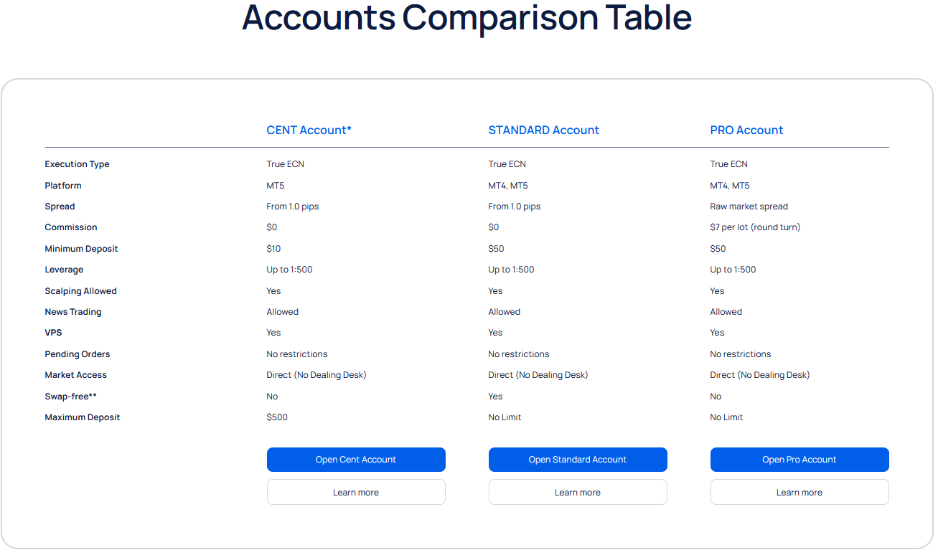
Upon checking the available account types, the broker provides three distinct accounts to serve traders at varying experience levels. The accounts differ in minimum deposit requirements, pricing models, and trading conditions while maintaining digital onboarding and broad accessibility.
Account Type | Minimum Deposit | Accessibility and Features |
Cent Account | $10 | Targeted at beginners. Offers micro lot sizes for practice and exposure to real-market conditions with limited risk. Available on the MT5 platform only. |
Standard Account | $50 | Designed for general retail traders. Spread-only pricing with standard lots. Supports MT4 and MT5 platforms. An Islamic (swap-free) option is available. |
Pro Account | $50 | Focused on active and professional traders. Offers raw spreads plus commission, standard lot sizes, and ECN execution. Supports all trading styles on MT4 and MT5 platforms. |
Leverage is consistent across all account types at up to 1:500. All accounts permit scalping, hedging, and automated trading through Expert Advisors. Geographic availability is broad, though certain restricted regions are excluded. The onboarding process is fully digital, allowing clients to open accounts efficiently without extensive procedural barriers.
The account structure provides clear differentiation between beginners, retail traders, and professional users. Transparency is generally sufficient, though specific contract sizes and spreads for the Cent Account are not publicly disclosed.
Under COR evaluation, Key to Markets earns a score of 4 out of 5. This corresponds to differentiated account types with accessible entry points and clear trading conditions, while acknowledging that advanced institutional or highly specialized accounts are not offered at this stage.
Key to Markets provides a range of supplementary services that improve trading execution, automation, and partner engagement. The offerings focus on practical tools and infrastructure rather than promotional or peripheral features.
Trading & Automation Services
Copy Trading Platform – In-house social trading system that allows clients to follow or provide strategies. Fully integrated within the broker’s infrastructure without reliance on external platforms.
PAMM (Percentage Allocation Management Module) – Managed account solution that enables capital allocation to experienced traders through pooled investment structures.
Technical Infrastructure
Free VPS Hosting – Virtual Private Server access for clients running automated strategies. Supports continuous trading with stable connectivity and reduced latency.
FIX API Connectivity – A direct market access solution designed for advanced users. Supports custom system integration and faster execution through direct liquidity connections.
Partnership & Loyalty Programs
Introducing Broker (IB) Scheme – Partner program with rebate structures and a dedicated portal for tracking referrals and commissions.
Partner Loyalty Program – Tier-based incentive system that rewards long-term partners based on activity and client retention.
The broker offers multiple relevant services across execution, automation, and partner programs. These features provide practical benefits, though some services are more applicable to specific user groups, such as algorithmic traders or partners, rather than all clients.
Under COR criteria, this aligns with the 4 out of 5 score definition of “Broad Selection, Relevant, and Mostly Accessible.” The offering covers key categories such as VPS hosting, automated trading solutions, and advanced execution tools, though it does not extend into areas such as premium research or tax-related services.
Upon examining the broker’s corporate disclosures across its website and public records, the following points reflect the level of transparency, accessibility, and clarity provided:
Ownership is traceable through Companies House filings, identifying Giancarmelo Spampinato and Andrea Sabatini. This information is not disclosed on the broker’s website, which limits direct access to clients.
The firm operates through entities in the United Kingdom, Mauritius, New Zealand, and Dubai. Public materials do not explain how these entities are linked or which entity holds control over the group.
No executives, directors, or management team are identified on the website. There is no supporting section that outlines leadership or operational oversight.
No parent company or ultimate controlling entity is disclosed. The ownership chain remains unclear beyond registry-level data.
There are no published details on governance structure, board oversight, or internal controls.
The available data confirms that parts of the ownership structure exist and can be verified externally. However, key details on leadership, governance, and group control are not disclosed in a way that supports straightforward review.
Under COR criteria, this fits “Limited Transparency & Difficult Verification.” The broker provides partial information with gaps that require external validation. A 2/5 rating remains appropriate.
Upon examining the broker’s regional reach and operational footprint, our research team pinpoints a broad global client access coupled with limited physical presence and regulatory penetration.
The broker’s main operational base is in Mauritius. Additional offices operate in Cyprus and Dubai. Prior locations, such as London and Auckland, are either inactive or unclear in status. The operational footprint is primarily administrative rather than localized market engagement. On the other hand, it provides services across Europe, Asia, Africa, and Latin America, with an active client base spanning over 100 countries. Core markets include Italy, Malaysia, and Nigeria. Access is restricted in major jurisdictions such as the United States, Canada, Japan, and the United Kingdom.
Its platform and website offer multiple languages, including English, Arabic, Hindi, Chinese, Spanish, and Portuguese. These provisions facilitate regional accessibility, particularly across emerging markets, though deeper localization remains limited.
Regional payment infrastructure is in place. Asia integrates UnionPay, Latin America utilizes PayRetailers, and Africa supports Korapay for mobile money and local bank transfers. These methods enable operational functionality but remain limited to selected providers per region.
Our research indicates that the broker achieves moderate market penetration and provides basic localization through language and payment options. Regional operations and on-the-ground engagement remain limited, reducing the depth of market integration.
Based on COR criteria, this sub-factor aligns with “Moderate Penetration, Reasonably Localized, Limited Local Footprint & Moderate Marketing.” The broker demonstrates functional global reach with partial localization, but physical and regulatory presence remains constrained. A 3/5 rating is consistent with these findings.
We conducted a detailed review of Key to Markets’ legal documentation to evaluate its comprehensiveness, clarity, and client accessibility. Our research team identifies that the broker meets core regulatory obligations, yet there are areas requiring improvement in clarity and presentation.
The broker offers the essential documents required for offshore brokerage operations. These include:
Client Agreement
Risk Disclosure
Privacy Policy (GDPR-compliant)
Complaint Policy
Terms and Conditions
Anti-Money Laundering (AML) Disclosure
Conflicts of Interest Policy
All documents are accessible from the website and client portal.
Documentation covers key regulatory requirements. Risk disclosures contain appropriate warnings, and the complaint procedure defines response timelines, including a three-business-day acknowledgment and seven-business-day resolution. Privacy policies follow the GDPR structure. No evidence of misleading clauses, hidden terms, or noncompliance was found.
Information is dispersed across multiple documents. Fee schedules, deposit and withdrawal charges, and swap/overnight calculation methods are not centralized, requiring users to cross-reference several sources. General transaction fees are stated at 2.5%, but exceptions per payment method are not consolidated. Dispute resolution is set under the Mauritius arbitration, which may create practical challenges for international clients.
Documents are present in the footer and account portal, but locating specific items requires effort. No simplified summaries or "Key Facts" sheets exist to guide clients. Navigation is not intuitive, and fees require additional cross-referencing to fully understand obligations.
Key to Markets delivers complete documentation that meets regulatory standards. Gaps in clarity, presentation, and centralized information reduce accessibility for clients and require additional effort to interpret key details.
Here are the key details regarding trading fees that traders should understand before investing. This section highlights spreads, commission structures, all-in costs, and transparency across the available account types.
Account Type | EUR/USD Spread | Commission | All-In Cost (EUR/USD) |
Standard (Fixed Spread) | 0.8–1.0 pips | None | 0.8–1.0 pips |
Pro (Raw ECN) | 0.3 pips (average raw) | $3–8 per round-turn lot | 1.0–1.5 pips (spread + commission) |
Typical index spreads range from 2 to 4 points for the Standard Account, while Pro Account spreads fluctuate according to raw market conditions and the applied commission. Commodity spreads for Standard accounts are generally around 2 to 3 pips, whereas Pro Account values are calculated based on raw spreads combined with commissions. Swap or overnight fees follow the instrument specifications and are fully disclosed in the contract documentation, with swap-free accounts available for eligible clients.
All trading costs are explicitly presented within the account specifications. For Pro Accounts, fees are separated clearly between spreads and commissions, allowing traders to determine total costs with precision. Standard accounts do not incur hidden or indirect charges, ensuring transparency in basic trading activities.
Overall, trading fees are consistent with industry averages. The fixed spreads of Standard accounts offer predictability, while Pro accounts provide tighter raw spreads with associated commissions for more active traders. Essential costs are disclosed sufficiently, although some details require consulting multiple sources or reviewing account specifications. In general, the trading fees are reasonable but not exceptionally low, positioning the platform in an average range regarding both competitiveness and transparency.
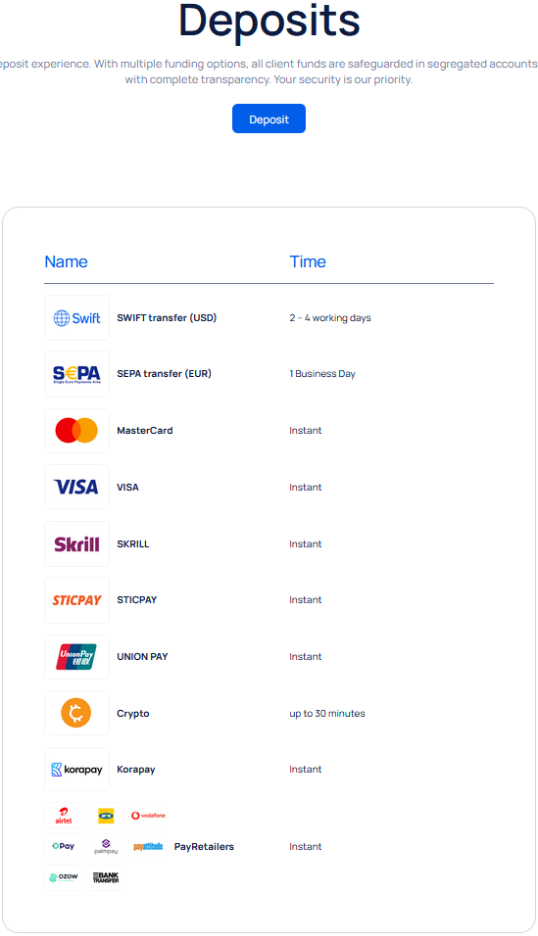
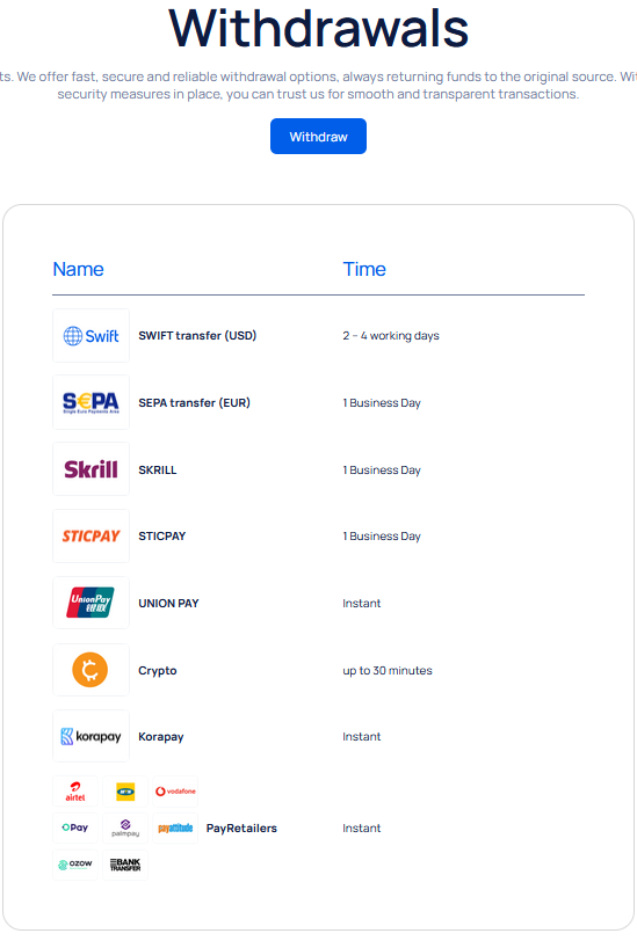
Key to Markets offers highly transparent and client-oriented funding policies. Deposits and withdrawals incur no internal fees, and the broker covers third-party processing costs. Multiple funding methods are available globally, allowing clients to have fast and reliable access to their funds without unexpected deductions.
Feature | Policy | Benefit to Client |
Internal Fees | None for deposits or withdrawals | Clients retain the full deposited or withdrawn amount |
Third-Party Costs | Broker absorbs applicable card/e-wallet fees | No deductions from payment methods that normally charge fees |
Payment Methods | Bank transfers, credit/debit cards, e-wallets, regional solutions, cryptocurrency | Flexible access across regions with multiple fee-free options |
Processing Speed | Instant for e-wallets/cards; 1–3 business days for bank transfers; blockchain-dependent for crypto | Fast account credit and withdrawal, predictable turnaround |
Withdrawal Limits | No minimum or restrictive conditions | Full access to funds at any time |
Transparency | All fees and policies are clearly disclosed | Eliminates unexpected charges or hidden costs |
Deposits via credit/debit cards and e-wallets are credited instantly, whereas bank transfers require standard banking times of 1-3 business days. Cryptocurrency deposits vary depending on blockchain processing. Withdrawals are processed within the same business day for most methods, with e-wallet withdrawals often completed in hours.
By absorbing processing fees, Key to Markets ensures clients are not penalized by third-party charges common among other brokers. All policies are fully disclosed, and no hidden or indirect fees apply. Currency conversion fees, if any, are minimal and explicitly stated.
Active traders benefit significantly, as the absence of deposit and withdrawal fees can save funds annually compared to fee-charging brokers. User feedback consistently highlights reliability, speed, and clarity of funding processes.
Under the COR framework, Key to Markets achieves a 5 out of 5. The broker demonstrates exceptional cost transparency, global payment flexibility, and fast, predictable processing. Clients experience minimal friction and retain full control over their funds, establishing confidence in the broker’s operational reliability and adherence to transparent financial practices.
We reviewed non-trading fees to assess costs outside active trading, including inactivity, account maintenance, platform access, VPS hosting, internal transfers, and currency conversion. Key details are summarized below:
Fee Type | Key to Markets Policy | Client Advantage |
Inactivity / Dormancy | $0, accounts remain open indefinitely | No penalties for inactive periods |
Account Maintenance / Closure | $0 | Free account verification, management, and closure |
Platform Access | MT4 / MT5, mobile and web apps are free | Full platform functionality at no cost |
VPS Hosting | Free for eligible clients | Saves $240–480 annually |
Internal Transfers | Unlimited, fee-free | Move funds between accounts without cost |
Currency Conversion | Market rate, no markup | Transparent, fair exchange rates |
Key to Markets imposes virtually no non-trading fees. Clients retain full access to accounts regardless of inactivity, and all essential services and platforms are available without charge. VPS hosting and internal transfers are free, further reducing costs for active and algorithmic traders. Currency conversions apply only to market rates with no hidden markups.
User feedback confirms the absence of unexpected charges. The fee-free structure builds trust, signals transparency, and removes financial friction outside of trading activity.
Under the COR framework, Key to Markets scores 5 out of 5. The broker demonstrates a fully transparent, client-focused policy with minimal operational costs outside trading. Any services that could trigger fees are either free or clearly disclosed, ensuring fairness and predictability for all clients.
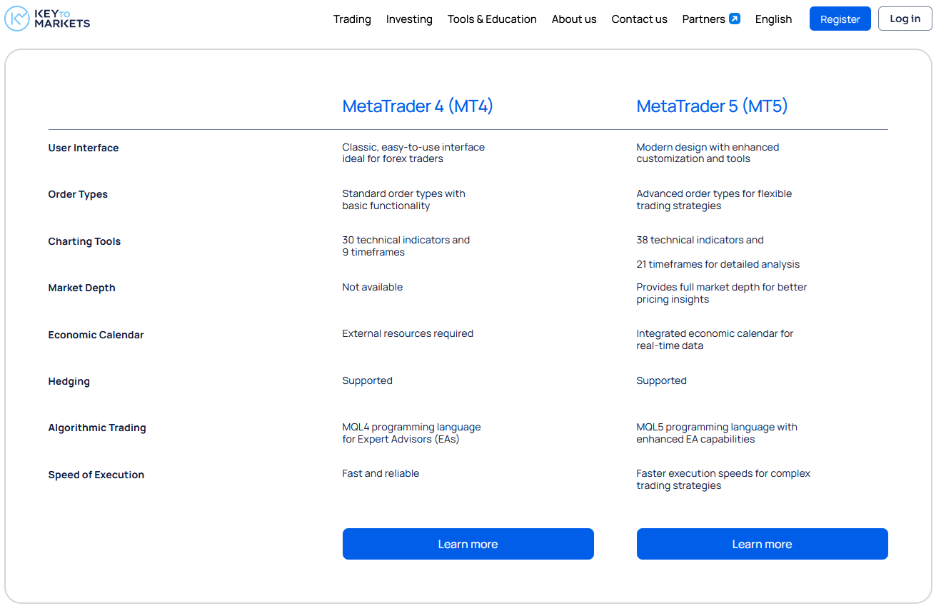
Our review examined the availability, accessibility, and usability of the broker’s trading platforms across supported devices. The focus is on platform coverage, ease of access, interface design, and consistency of performance during regular use.
Platform Overview
Platform | Type | Devices | Key Characteristics |
MT4 | Third-party | Desktop (Windows/Mac), Web | Established interface, widely recognized layout |
MT5 | Third-party | Desktop, Web, Mobile | Updated interface with broader functionality |
Web Terminal | Browser-based | Any browser | No installation required, accessible via browser |
Mobile (iOS/Android) | Third-party | Mobile devices | Full account access with responsive layout |
Platform access is straightforward across all supported devices. Installation steps are clear, and login remains consistent whether accessed through desktop, browser, or mobile. Transition between devices does not disrupt the user's session, which supports continuous access throughout the trading day.
The interface follows the standard MetaTrader layout. Most users will find it familiar, reducing the need for a learning curve. Navigation is structured in a way that keeps essential functions visible and easy to reach. The mobile and web versions maintain usability without removing core functions, which helps preserve consistency across devices.
Platform stability remains dependable under normal conditions. There are no recurring reports of access interruptions or persistent technical issues that would affect routine use.
The platform range remains limited to MetaTrader. There is no proprietary system or alternative interface. The overall design remains functional but unchanged, which may not appeal to users expecting a more refined or modern environment.
The 4/5 rating aligns with “Very Good Stability, Broad Accessibility & Strong User Experience.” Platforms are reliable, accessible across devices, and easy to operate. The absence of platform variety and limited interface differentiation prevents a higher score, although overall usability remains solid.
Our review focused on how orders are executed in live conditions, with attention given to speed, consistency, slippage behavior, and pricing accuracy. The objective is to assess how closely actual trade outcomes align with expected market conditions, particularly during both stable and volatile periods.
Execution performance falls within standard industry ranges. Most orders are completed within roughly 200 to 500 milliseconds, with a large majority filled within one second. This level of speed supports routine trading activity without noticeable delay. Pricing remains generally aligned with quoted levels, although minor deviations can occur when markets move quickly. Slippage is present in both directions, with a portion of trades executed at the requested price and others filled slightly above or below. This pattern indicates a balanced outcome rather than a controlled or optimized slippage environment.
Order reliability remains acceptable under normal conditions. There are no consistent reports of failed executions or systemic disruptions. However, performance becomes less stable during periods of heightened volatility. In such instances, slippage becomes more pronounced, and isolated cases have been noted where stop orders were filled at levels not reflected on visible chart data. These incidents appear infrequent but indicate limitations in price consistency during fast market movements.
The 3/5 rating aligns with “Adequate Execution Speed, Reasonable Slippage Control, and Standard Pricing Accuracy.” Execution speed and order handling meet baseline expectations, and pricing remains broadly consistent. Variability under volatile conditions and the absence of tighter control over slippage limit the overall standing to a mid-range assessment.
Upon reviewing the broker’s analytical environment, the available tools center on the standard MetaTrader ecosystem, supported by a limited set of external integrations and basic in-house resources. The coverage addresses essential analytical needs, though it remains within typical industry standards without extending into more advanced or proprietary capabilities.
MetaTrader Suite (MT4/MT5) - Provides built-in technical indicators, charting tools, and full support for Expert Advisors and custom indicators. This setup accommodates both manual and automated trading approaches.
Third-Party Integrations - Includes Myfxbook AutoTrade and SignalStart for copy trading and strategy tracking. These integrations expand functionality but depend on external platforms rather than internal development.
Economic Calendar & Calculators - Covers basic requirements for tracking economic events and managing trade calculations such as margin and position sizing.
Research & Educational Content - Offers a research blog, introductory materials, and occasional webinars. Content remains general in scope and does not provide consistent in-depth analysis.
API Access (FIX API) - Supports advanced trading setups for users requiring direct connectivity and automated execution.
The toolset supports routine market analysis and trade preparation without usability concerns. However, the absence of proprietary analytics, advanced screening tools, or integrated market intelligence limits its depth compared to more developed offerings.
The 3 out of 5 rating corresponds with an average level of analytical support. The tools remain functional and accessible, though the overall depth and innovation do not exceed standard industry expectations.
Key to markets differentiates through innovative features, including the Key to Savings account offering 3% annual interest on idle funds and in-house copy trading and PAMM services built directly into its client portal.
Notably, the firm offers FIX API access and cryptocurrency funding options. It also integrates Myfxbook AutoTrade and SignalStart for proven copy trading technologies and uses oneZHub for ECN connectivity to multiple liquidity sources. Additionally, the KeyToProp program expands the business model beyond conventional retail trading.
The company regularly introduces innovative technologies and advanced features ahead of many competitors. It provides reliable and effective integration with major third-party platforms. Moreover, it suggests APIs suitable for automated and algo trading.
Under the COR framework, the broker earns 4 out of 5 for this sub-factor. The technological offering strongly supports diverse trading styles. It actively updates and improves technology infrastructure, with minor areas needing improvement.
We conducted direct testing of the broker's customer support, and here are the findings across different arrays of their communication channels alongside each respective quality:
Availability & Coverage - Support operates 24/5, aligned with global trading hours. There is no full 24/7 coverage, which may limit assistance during weekends or off-market periods.
Communication Channels - Clients can reach support through live chat, email, and telephone. These channels are clearly listed and accessible from the client portal and website.
Response Time - Live chat responses are typically received within a few minutes during active hours. Email inquiries are commonly addressed within the same business day. Phone support provides immediate assistance, subject to availability.
Quality of Assistance - Support handles standard concerns such as account access, funding, and platform navigation with clear and accurate responses. More technical or account-specific issues may require follow-up exchanges before resolution is completed.
Consistency & Resolution - Most inquiries are resolved within a single interaction for routine matters. Cases involving technical clarification or account verification may take longer, though there are no recurring reports of unresolved issues.
The service maintains a dependable level of support across its channels. Response times remain within acceptable ranges, and the information provided is generally accurate. However, the absence of round-the-clock availability and occasional need for follow-ups indicate room for improvement in responsiveness and depth.
The 4 out of 5 rating aligns with “Very Good Customer Support” in the COR framework. The broker delivers reliable multi-channel access and timely responses during trading days, though it does not reach the responsiveness or continuity associated with top-tier, 24/7 support providers.
Upon reviewing Key to Markets’ educational offerings, the broker provides a well-organized suite of resources that demonstrate credibility and reliability for traders. The materials are designed to support skill development, which guides users from basic principles to more advanced trading concepts across multiple markets like Forex, CFDs, and Shares. Users consistently recognize the professional quality of these resources.
Learning Formats Available
Static articles and guides providing written explanations of trading concepts
Webinars offering live sessions on trading strategies and platform tutorials held periodically
Video tutorials archived on the broker’s YouTube channel and blog
Glossary covering essential trading terms for newcomers
FAQ section addressing operational and procedural questions
Demo accounts enabling hands-on practice without financial risk
After these resources are introduced, Key to Markets offers structured learning that progresses from introductory topics to intermediate subjects. Beginners start with basic concepts such as how Forex works and how CFDs function, then move to analysis techniques and trading strategies. Weekly market updates and daily analysis posts show how to interpret news and technical patterns, providing practical insight into market behavior. Support articles explain trading conditions, margin requirements, and risk management, while transparent explanations enhance overall trader understanding.
The broker’s educational offerings primarily target beginner and intermediate traders. Advanced interactive features are limited, and webinars are held periodically rather than weekly. Under the COR framework, Key to Markets earns a 4 out of 5 rating for educational resources, which corresponds to an extensive, structured, and regularly updated content that supports trader learning and practical application.
Key to Markets does not operate a proprietary trader forum or internal social network on its site. Instead, it maintains an active presence on third-party platforms. Nevertheless, its Copy Trading and PAMM services inherently create community-like dynamics. PAMM managers and investors form communities of interest where multiple stakeholders are affected by manager trades.
The firm has also run trading contests and offers loyalty programs such as Partner Loyalty for introducing brokers and possible points programs for traders. The award-winning affiliate/IB program supports a community of introducers and regional partners who create local communities through seminars and training sessions.
Furthermore, the company provides adequate avenues for communal engagement through social media, copy trading networks, Telegram groups, and trading contests. On balance, it earns 3 out of 5 on this subfactor. It suggests adequate, moderately active community services, such as basic client forums or simple social trading platforms with moderate user activity.
The social or copy-trading services exist, but with limited engagement or functionality. Basic platforms for user-generated content or trader collaboration are present, though activity levels and moderation may vary. Overall community support is standard, adequately meeting typical trader needs but without extensive features or activity.
Below is a step-by-step outline of the Key to Markets account setup and management process, based on platform testing and user feedback:
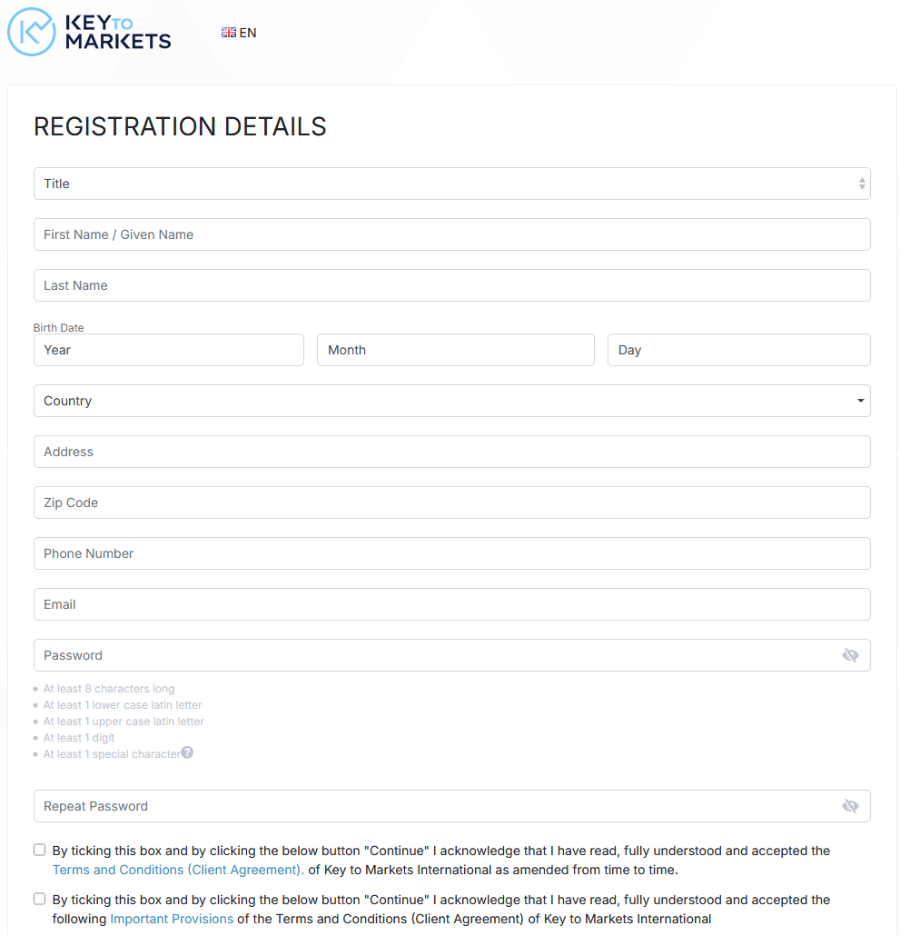
Step 1: Account Registration and Initial Access
Account creation is fully digital through the web portal, with optional social integration via Google or Facebook for convenience. Users submit personal details and set a secure password to gain initial access to the client dashboard. This immediate access allows users to explore basic platform features and create demo accounts before completing full verification, reducing friction for new traders.
Step 2: Client Portal Access and Profile Setup
The client portal serves as a central hub for account management. Navigation is consistent across desktop and mobile browsers, with a mobile-responsive design. Users complete their personal profile and securely upload KYC documents, including government-issued ID and proof of residence. At this stage, demo accounts are available, allowing traders to practice and familiarize themselves with platform functions without financial risk.
Step 3: Identity Verification (KYC Submission)
Verified identity is required for deposits, withdrawals, and live trading. Document reviews are fast, typically processed within a few hours or on the same day on weekdays. Users receive clear updates on approval status or required resubmissions, ensuring transparency and reducing uncertainty. Weekend submissions are processed on the next business day, reflecting the broker’s weekday-only support schedule.
Step 4: Account Activation and Funding Readiness
Upon verification, accounts become fully active. Clients can deposit funds using cards, e-wallets, or internal transfers without redirection. The platform supports multiple trading accounts under a single profile, including MT4 and MT5 accounts, with a choice of base currency and account type. Internal transfers between accounts are processed instantly without requiring support intervention, simplifying capital allocation. The minimum deposit is $50 or less, providing accessible entry for new traders.
Step 5: Ongoing Account Management
Account administration is handled entirely through the portal or a basic mobile app. Clients can monitor balances, positions, transaction history, and document status. Leverage adjustments, Islamic account conversions, and personal detail updates are self-service and processed within one business day. Margin levels, stop-out triggers, and real-time margin metrics are clearly displayed, ensuring traders can make informed decisions. Demo accounts allow seamless switching to live trading, promoting hands-on learning.
Step 6: Account Changes and Exceptional Scenarios
Opening additional accounts, requesting swap-free Islamic accounts, or closing inactive accounts is straightforward. Exceptional cases, such as complex fund recovery or special requests, may require support guidance, but routine operations remain user-friendly and self-service.
The account setup and management process is smooth, efficient, and largely friction-free. Fast verification, a centralized dashboard, instant internal transfers, and consistent cross-device performance are key strengths. Minor improvements could include faster weekend document processing and enhancements to the mobile app experience. For these reasons, the broker earns a score of 4 out of 5 under the COR framework.
The TRU Comprehensive Organization Rating (COR) is an evidence-based scoring framework that evaluates a company across key dimensions that matter to traders and platform users. It is designed to provide a standardized and objective view of a firm beyond popularity or isolated user opinions.