OctaFX operates through multiple legally registered entities across different jurisdictions, and these can be verified through official registries.
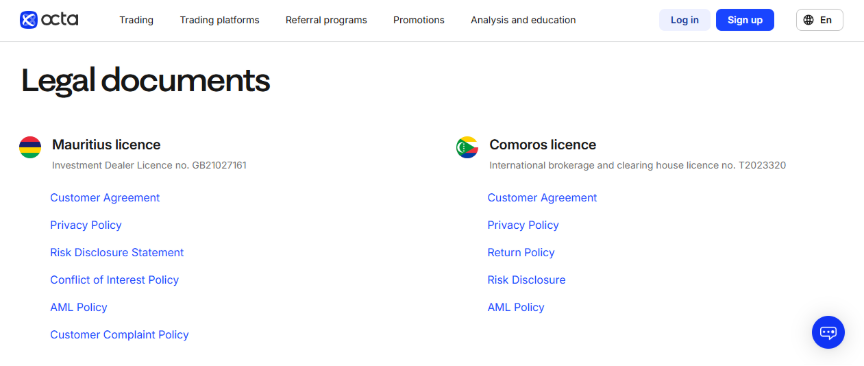
The primary corporate entities include:
Octa Markets Ltd in Comoros, registration no. HY00623410)
Uni Fin Invest in Mauritius, company no. C186509.
Additional affiliated companies exist in other regions, such as:
Octa Markets Cyprus Ltd, Cyprus, company no. 359992
Orinoco Capital (Pty) Ltd in South Africa.
All these entities are traceable via public corporate or regulatory records, indicating that OctaFX’s business is incorporated in identifiable jurisdictions. However, not all these registrations are prominently disclosed on OctaFX’s main website or client-facing materials.
The company’s legal footprint is extensive and verifiable, but because it does not clearly publish every entity’s details on its main site, independent verification requires extra effort. This is consistent with a “Published but could not be easily verified” scenario under the COR criteria.
OctaFX’s active entities place the broker mainly in COR’s Tier-3 offshore environments.
Its principal companies operate from Mauritius and the Union of Comoros (Mwali), which COR classifies as low-tier jurisdictions with light oversight and limited credibility. They offer basic incorporation but lack transparency and strong financial supervision, leaving traders with minimal regulatory protection.
OctaFX also has entities in Cyprus (Tier-1 EU) and Saint Lucia, but the Cypriot arm (Octa Markets Cyprus Ltd) serves only EU clients and is not featured on OctaFX.com.
Because its global operations do not highlight this stronger registration, most customers gain no benefit. In practice, core business runs from jurisdictions with moderate to low regulatory rigor.
Therefore, the broker ranks mid-range for this sub-factor: its entities are legitimate and verifiable, but reliance on multiple Tier-3 jurisdictions and limited emphasis on its Tier-1 presence keep the score at 3/5 under COR’s “Multiple Tier-3 jurisdictions” classification.
Octa Markets Ltd in Comoros is licensed as an “International Brokerage & Clearing House” by the Mwali International Services Authority (T2023320), and Uni Fin Invest in Mauritius is an Investment Dealer under the Financial Services Commission (GB21027161). Both licenses are publicly verifiable through their regulators. The brand also holds a Cyprus Investment Firm (CIF) license under CySEC (372/18) and is registered as a Financial Services Provider in South Africa (FSP 51913 under FSCA).
These credentials confirm that OctaFX has undergone formal authorization in multiple regions. However, its global site does not prominently display the CySEC or FSCA licenses, marketing primarily under offshore licenses for most clients. Still, the presence of valid licenses places it above unlicensed brokers. All claims were verified by the issuing authorities, though finding details requires effort since OctaFX itself highlights only some publicly.
Overall, licensing across four jurisdictions supports a strong score of 4/5 for this sub-factor.
Although OctaFX does hold licenses, their main operational permits come from the FSC Mauritius and the Mwali Financial Authority in Comoros, which are regarded as Tier-3 regulators in the Regulatory Reputation of TRU’s COR framework.
Our analysts note that the CySEC-regulated entity’s stricter protections, such as EU investor compensation schemes, do not apply to most clients outside the EU. As a result, the regulatory experience with OctaFX is largely that of an offshore broker, not one under top-tier oversight. MISA and FSC lack strong reputations, as they are not known for proactive audits or robust enforcement compared to Tier-1 authorities like the UK’s FCA or Australia’s ASIC. With client safety relying on these lower-tier regulators, confidence in its compliance environment remains limited.
Therefore, OctaFX meets basic regulatory requirements on paper, but the caliber of its oversight aligns with COR’s 2/5 rating.
OctaFX’s history reflects multiple regulatory infractions and warnings in key markets, showing a pattern of operating outside strict local rules.
In March 2024, the Philippines’ SEC declared OctaFX an unregistered investment platform and worked with the National Telecommunications Commission to block its website. Earlier, in Sept 2023, the SEC issued advisories for operating without a license, and its 2024 action formally banned OctaFX as an unauthorized securities/futures dealer.
Around the same time, India’s Enforcement Directorate (ED), in its public communications, alleged that entities linked to the OctaFX brand had, since 2019, operated an online trading scheme that, in the ED’s view, breached India’s forex rules and involved offences under the Prevention of Money Laundering Act (PMLA). According to these ED reports, cases were filed under the PMLA and, by 2025, the agency announced provisional attachment and freezes of assets, including approximately US$271 million in cryptocurrency and high-value property associated with individuals described as executives of the group. Separately, in July 2025, SEBI imposed a fine of about US$37,000 on Tauga Pvt Ltd (formerly OctaFX India) for operating an unregistered platform, after which that entity surrendered its license and ceased operations in India.
Other regulators flagged OctaFX as well: Malaysia’s Securities Commission listed it on an Investor Alert in 2020, and Singapore’s MAS blocked its site in mid-2025 for serving residents without a license.
Across the Philippines, India, Malaysia, and Singapore, official advisories and enforcement actions have been issued in relation to OctaFX or entities using its brand. On that basis, and under the COR framework, we rate OctaFX’s compliance record as 2/5 (‘Poor Compliance History’).
OctaFX exhibits an adequate but not advanced approach to cybersecurity.
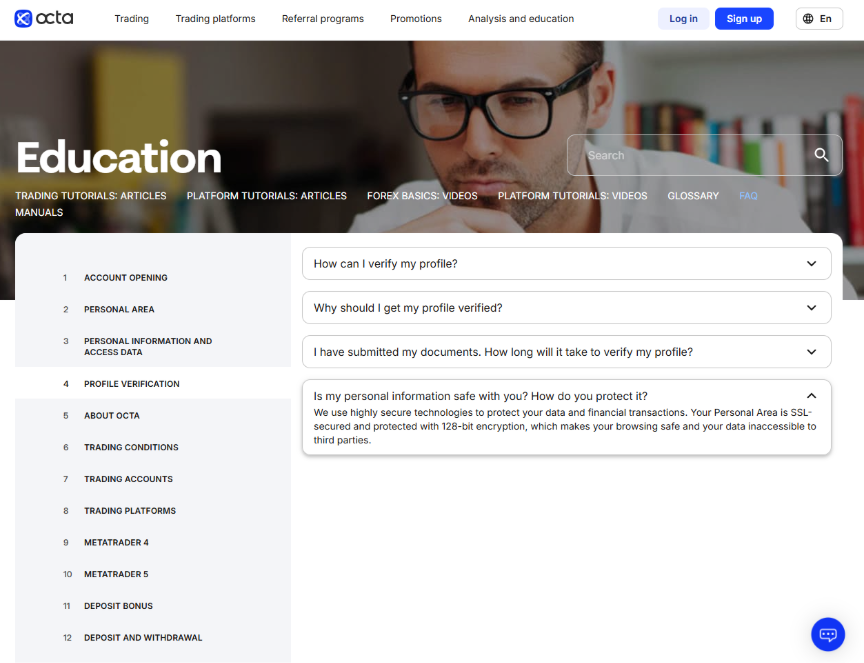
Its website communications are secured by SSL encryption, and the client portal is protected with 128-bit encryption to safeguard data. It also implements 3D Secure (3DS) authentication for Visa/MasterCard transactions and employs standard protections for its online platforms and client areas.
Two-factor authentication (2FA) is mentioned in OctaFX’s support materials for account login or transactions, though its implementation appears inconsistent, as it may sometimes be optional or limited to certain methods. Alongside SSL, encryption, and 3DS, these measures provide a baseline level of IT security comparable to industry norms for retail brokers.
However, OctaFX does not disclose advanced cybersecurity certifications or independent audits. There are no ISO 27001 certifications, SOC 2 reports, or published penetration test results. Its security features remain basic, with no evidence of sophisticated defenses like active intrusion detection or regular third-party assessments.
The lack of high-level safeguards or compliance with international standards suggests OctaFX’s IT security, while adequate for daily operations, is not at an advanced level. Although no major breaches have been reported, transparency on cyber resilience is limited.
Overall, OctaFX covers fundamental practices, earning a middle-tier score of 3/5 (“Adequate Cybersecurity”). Its security is generally acceptable and keeps clients reasonably safe, but lacks robust protocols or certifications to merit a higher rating.
OctaFX offers mixed protection for client funds, with significant differences depending on the entity a client falls under.
It claims to segregate client money from operational funds, holding them in separate accounts. This is a basic requirement for regulated brokers. It also provides negative balance protection to ensure clients cannot lose more than their deposits.
Some entities participate in external dispute resolution or compensation schemes. OctaFX is a member of The Financial Commission, which covers clients up to €20,000 in case of broker default or dispute. Its CySEC-regulated arm also provides access to the Cyprus ICF compensation of up to €20,000.
However, these protections are uneven. Coverage via The Financial Commission or an Investor Compensation Fund applies only to clients under specific entities. Clients under Uni Fin Invest (Mauritius) or the now-closed Octa Markets Incorporated (previously St. Vincent, now St. Lucia) have no equivalent scheme. In those cases, customers rely solely on internal fund segregation and general legal frameworks, without statutory or insurance backstops if the broker fails.
Offshore regulators do not mandate investor insurance or guarantee fund participation, and OctaFX does not advertise any private insurance for bankruptcy or fraud scenarios. This patchwork approach leaves a large portion of its client base, especially in Asia and Africa, which are served by offshore entities without formal deposit insurance, while a minority, such as EU clients or those covered by The Financial Commission, have limited €20,000 protection.
Given the lack of uniform, high-quality fund safety measures, OctaFX merits a score of 2/5 for “Minimal Client Fund Protection.” While it segregates funds and offers negative balance protection, transparency and assurances are lacking. There is no robust guarantee that client funds are safe in worst-case scenarios, especially under offshore entities. Strengthening this would require extending recognized compensation schemes or insurance to all clients and providing clearer proof of safeguards.
OctaFX gives access to a moderate range of asset classes, covering the core categories expected from a CFD broker but little beyond that.
Clients can trade forex pairs, stock CFDs, major indices, several commodities, and popular cryptocurrencies. This covers the typical needs for most retail traders operating across these markets.
However, its asset menu does not include more specialized classes. There is no trading in bonds or ETFs, and no mutual funds or futures contracts.
In essence, OctaFX supports about five to six asset classes (Forex, Indices, Commodities, Stocks, Crypto), placing it mid-range under COR criteria. Its focus is clearly on mainstream CFD instruments rather than a broad multi-asset offering. This works for standard strategies but may not suit traders seeking less common markets.
Therefore, OctaFX scores 3/5 for asset class availability, matching “Moderate Asset Class Coverage.” It covers the basics but omits significant classes like bonds and ETFs, so traders needing those would require other brokers.
The total roster of individual trading instruments at OctaFX is respectable but not huge, aligning with a mid-tier broker.
As of writing this review, OctaFX advertises 230 instruments in total on its platform. In practical terms, this includes:
This count gives traders a decent range of choices within each asset class without being overwhelmed. The stock CFD list focuses on widely followed companies, offering equity exposure without thousands of options. The crypto selection includes top coins like BTC, ETH, LTC, and some altcoins.
Diversity across asset classes is balanced, but depth is average. For example, more than 50 forex pairs and about 150 stocks are moderate compared to larger brokers with broader catalogs.
Given this scope, OctaFX provides enough markets for typical retail trading and basic diversification but falls short of extensive coverage. Under COR scoring, this earns a 3/5 rating, “Moderate Number and Reasonable Diversity.” Traders will find all primary markets represented and a few hundred instruments sufficient for intermediate needs, though those seeking very broad access may find OctaFX limited.
OctaFX’s account offerings are straightforward and fairly uniform, which has both advantages and drawbacks.
It essentially offers three main account types, each tied to the trading platform choice:
MetaTrader 4
MetaTrader 5
OctaTrader, its proprietary platform
In practice, these accounts have very similar conditions. All of it requires a low minimum deposit of $25, runs on a spread-only model with no trading commissions, and, depending on the instrument, leverage that can go up from 1:500 to 1:1000.
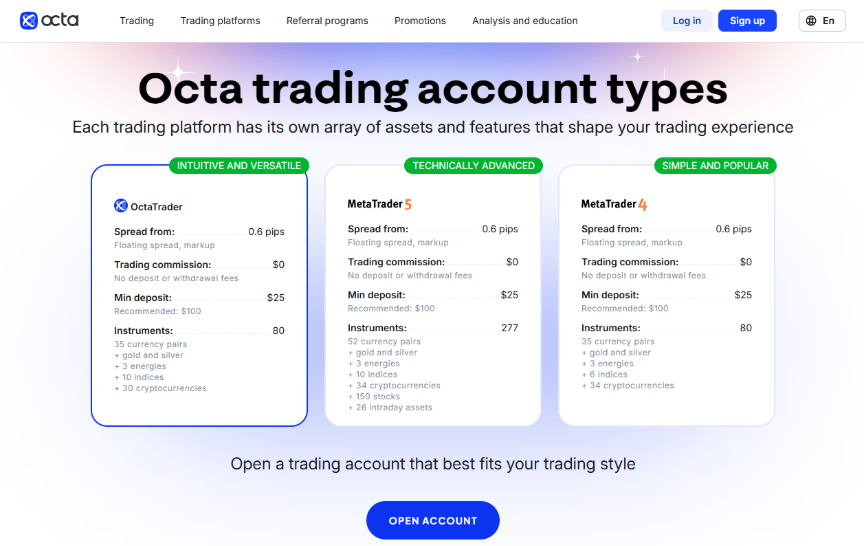
While the OctaTrader account has a slightly reduced list of indices and crypto, the MT4 and MT5 accounts mirror each other in available instruments. This consistency means there are no tiered “beginner” vs “VIP” accounts, as every client gets similar trading conditions without requiring larger deposits for better spreads, which is positive for accessibility.
Islamic (swap-free) accounts are also available. Instead of a separate account type, OctaFX allows any user to toggle an Islamic mode (no overnight interest), catering to clients who need Sharia-compliant trading.
There is no multi-currency account option; accounts are generally in USD and a few other base currencies, but not a broad selection beyond majors. While the minimum deposit is very low, the simplicity of account choices may not appeal to those seeking premium services or custom conditions.
Account Types | Spreads | Commission | Minimum Deposit | Trading Instruments |
MetaTrader 4 | 0.6 pips | 0 | $25 | 80 trading instruments (35 currency pairs, gold and silver, three energies, 10 indices, and 35 cryptocurrencies |
MetaTrader 5 | 0.6 pips | 0 | $25 | 80 trading instruments (35 currency pairs, gold and silver, three energies, 10 indices, and 35 cryptocurrencies |
OctaTrader | 0.6 pips | 0 | $25 | 80 trading instruments (35 currency pairs, gold and silver, three energies, six indices, and 34 cryptocurrencies |
Overall, OctaFX’s account type and accessibility can be described as “Moderately Differentiated and Accessible.” It offers essentially one standard account with platform variants, an Islamic option, and only minor regional restrictions aside from barred countries. It neither excels in variety nor falls short in availability.
OctaFX goes beyond the essentials by offering supplementary services that enhance the trading experience, placing it above average in this category.
Its flagship feature is a Copy Trading platform integrated into the OctaFX ecosystem. This service lets clients follow and automatically copy trades from expert strategy providers, creating a social trading network within OctaFX. The interface is available on both web and mobile for accessibility and convenience.
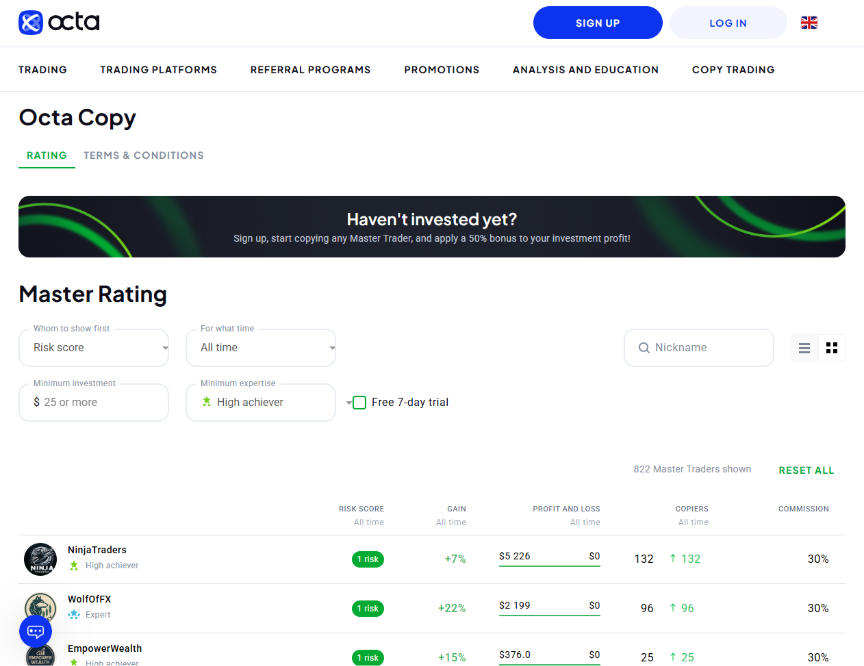
In addition, OctaFX offers a broad suite of analytical tools and resources. On its website and Personal Area, traders can access an economic calendar, trading calculators, live quotes, and a trading hours/market holidays calendar. These tools help users plan trades and manage risk without external tools.
For technical traders, OctaFX provides a free VPS (Virtual Private Server) for qualifying accounts. This enables continuous uptime and faster execution for automated strategies or expert advisors, a perk typically offered by brokers catering to algorithmic traders.
OctaFX also runs occasional promotions and contests, such as demo competitions, deposit bonuses in certain regions, and loyalty programs with status-based rewards, though these vary by time and jurisdiction.
These extras add significant value beyond the standard platform, reflecting OctaFX’s commitment to a comprehensive trading environment. The main gap is the absence of advanced in-house research or premium third-party integrations beyond Autochartist.
Considering the scope and relevance of these services, OctaFX scores 4/5 on this sub-factor. The offerings span multiple categories and are available to most clients.
OctaFX provides very limited information about its ownership and governance, raising concerns about integrity and accountability.
It discloses its operating companies and licenses but does not reveal who ultimately owns or controls the group. There is no publicly available information on beneficial owners, major shareholders, or any parent holding company. Key executives or directors are also not identified on its website in an “About Us” section or corporate profile.
OctaFX’s marketing is brand-focused and largely anonymous regarding leadership. Investigations have linked it to certain individuals, but the company has never confirmed names and distances itself when pressed.
It is privately held and admits it has never fully disclosed its organizational structure. This lack of transparency is unusual for a broker of its size and global reach; many competitors at least list board members or ownership groups.
While OctaFX has recently tried to clarify its “brand-sharing model” with independent entities, it still does not explain how these tie together financially or managerially. There is no mention of a unifying holding company or where profits ultimately flow.
Corporate details are difficult to verify beyond registration, as confirmation requires internal records.
Given these factors, OctaFX falls into a low tier for corporate openness. It scores 2/5, reflecting “Limited Transparency & Difficult Verification.” It shares only minimal corporate info, with no clarity on ownership or leadership, making independent verification nearly impossible. This opacity can be a potential red flag for clients who value knowing the people and structure behind the service.
OctaFX has established itself as a global broker in client coverage and localization, but its physical presence and regulatory reach are limited.
It serves clients in over 180 countries, according to its statements, and offers its website and support in more than 10 languages, including English, Chinese, Indonesian, Hindi, Arabic, Spanish, and Portuguese—showing strong localization efforts. OctaFX also supports local payment methods in various regions, such as tailored deposit options for Thailand, Malaysia, Nigeria, and previously India.
Marketing includes region-specific promotions and sponsorships, reinforcing its international digital presence. However, aside from a representative office in Indonesia reported in 2012, there is little evidence of local offices; most clients are handled online through centralized support.
Regulatory restrictions prevent OctaFX from operating in major markets. It does not accept clients from the USA, UK, EU (except via its EU entity), Japan, Canada, or several high-risk or sanctioned countries. Due to enforcement actions, it also avoids or is blocked in India, the Philippines, Malaysia, Singapore, and other countries. While OctaFX advertises “180 countries,” some operate in gray zones under offshore permissions, leaving its effective regulated reach limited.
Its broad international client base and multi-language support boost its score, but the lack of substantial local presence and multiple country bans weigh it down. Overall, OctaFX stands at 3/5 for COR’s Geo Presence & Reach. This is a solid global online presence with localized features, but far from a strong local footprint in key financial hubs.
OctaFX provides a full set of legal and policy documents publicly, but their clarity and accessibility are average.
Its website includes all standard documentation expected of a broker, like Client Agreement, Terms and Conditions, Risk Disclosure, Order Execution Policy, Privacy Policy, AML policy, Conflict of Interest policy, and others. These are typically found in the “Legal” or footer section of the site, and they are accessible without registration.
The content covers OctaFX’s obligations and client-broker rules, so diligent traders can find details on rights, responsibilities, fees, and dispute resolution. However, the language is highly legalistic and dense, with heavy jargon and lengthy clauses that make it hard for an average retail trader to understand. There are no summary highlights or simplified explanations.
Some information is split across multiple documents, requiring cross-referencing. For example, fees or trading conditions may appear in FAQs or account pages rather than clearly in the Terms, making navigation harder. While documents are published, finding specific details often requires digging.
Our analysts found no misleading or contradictory content; the documents align with the services offered. The main drawback is readability and ease of use.
Under COR, OctaFX’s documentation is “Adequately Transparent & Accessible,” earning a 3/5 score. All essential documents are present and comprehensive, but sections are unclear and lack user-friendly summaries. Traders can inform themselves by reading the fine print, yet OctaFX does little to simplify or highlight critical points.
OctaFX’s trading fee structure is comparable to that of typical retail FX/CFD brokers, which are neither exceptionally cheap nor overly expensive.
The broker uses a zero-commission model across all account types, charging no separate per-trade commission on forex or CFD trades. Instead, it earns through spreads.
Spreads are generally competitive for a commission-free account: major pairs like EUR/USD average around 1.0–1.2 pips under normal conditions and can go as low as 0.6 pips. Spreads on indices and commodities are also in line with industry averages.
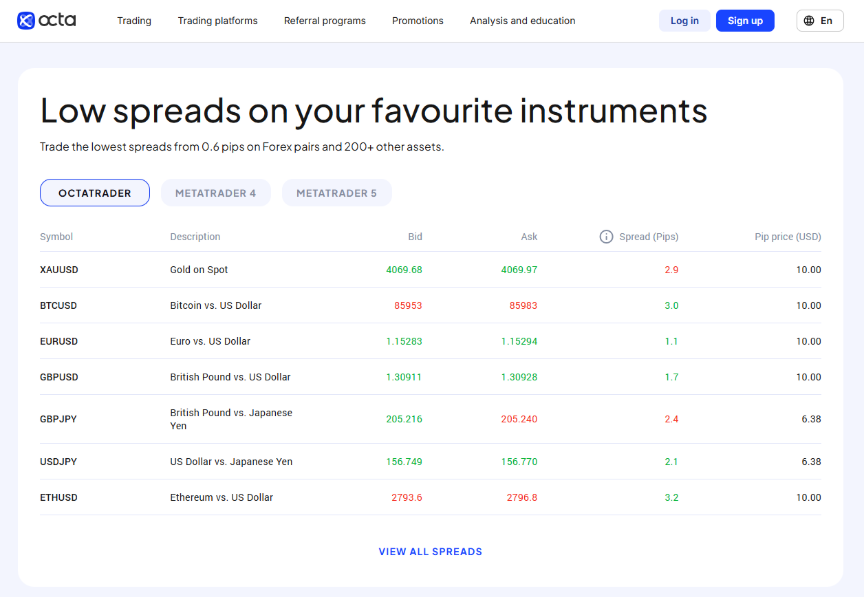
These spread levels are not the lowest in the industry since some brokers offer raw spreads near zero with a commission, but OctaFX’s model is straightforward and transparent. It publishes a detailed “Trading Instruments” specification on its website, listing typical spreads and overnight swap rates for each instrument.
Swap rates are standard, derived from interbank rates, and OctaFX does not appear to add excessive markup. As with any broker, swaps can impact long-term positions.
Positively, there are no hidden markups or unusual fee conditions. Stop order levels and trading terms are clearly stated, with no requote fees or mandatory account management charges.
Considering all this, OctaFX’s trading fees merit a middle-ground score of 3/5: “transparent and competitive enough for everyday trading,” though not ultra-low. Brokers with tighter spreads or zero spreads plus small commissions may score higher.
OctaFX ensures traders know their costs, which are roughly average. There are no extra trading-related fees like platform or mandatory VPS charges. While cheaper alternatives exist, its pricing offers a fair deal consistent with its offshore, commission-free model.
OctaFX excels in its fee-free and frictionless funding process, earning the highest marks for this sub-factor.
The broker does not charge any fees for deposits or withdrawals. When clients add or withdraw funds, OctaFX applies no commission or service charge. It also covers third-party payment fees in many cases. For example, absorbing costs from credit card or e-wallet processors so clients receive the full amount. This policy significantly reduces funding costs and is a strong competitive advantage.
TRU members confirm OctaFX charges no deposit or withdrawal fees and often covers third-party fees, which is rare in the industry.
OctaFX supports a wide range of funding methods: bank cards (Visa/Mastercard), e-wallets like Neteller and Skrill, various cryptocurrencies (Bitcoin, Tether/USDT, etc.), and local bank transfers in certain regions—all without internal fees. Minimum withdrawal amounts are low.
Processing times are fast: withdrawals are typically handled within 1–3 hours, far quicker than the industry norm of 1–2 business days. Actual receipt depends on the payment method, but OctaFX’s internal processing is swift.
The combination of zero fees, quick processing, and multiple channels makes funding highly user-friendly. OctaFX also avoids hidden currency conversion charges, using standard rates without extra cuts.
Overall, OctaFX’s deposit/withdrawal system is designed to be as seamless as possible, standing out in an industry where slow or costly withdrawals are common. Under COR criteria, this earns a 5/5 score for “no internal fees, fast processing, and diverse payment options”, exactly the description of top-tier performance in this area.
OctaFX is highly attractive when it comes to the absence of miscellaneous or administrative fees, warranting the top score for this sub-factor.
It does not burden clients with any inactivity fees, account maintenance fees, or other service charges that are unrelated to trading. If a client leaves their account idle for an extended period, OctaFX does not penalize them by deducting an inactivity charge. This is a policy that only a minority of brokers adopt. This means one can keep an account open indefinitely at no cost, which is especially beneficial for casual traders or those who return after a break.
OctaFX also does not charge for things like platform access, real-time quotes, or basic account services. Other potential non-trading fees that it could charge but does not include:
withdrawal/deposit fees
account closure fees
fees for paper statements
Aside from trading spreads and swaps, clients incur no charges simply for being with OctaFX. This transparent, customer-friendly fee policy places it among the top brokers for cost fairness. By avoiding such fees, 100% of a client’s funds remain theirs unless used in trading.
Under the COR framework, brokers with no significant non-trading fees earn full points, reflecting a commitment to avoid nickel-and-diming clients. OctaFX scores 5/5 here, matching “no hidden or recurring charges,” allowing accounts to be maintained at zero cost when not actively trading. This policy fosters trust and aligns with traders’ interests, positively impacting OctaFX’s overall rating.
OctaFX provides a range of trading platforms and delivers a high-quality user experience on each, meeting a strong standard in this category.
Clients can choose between MT4, MT5, and OctaTrader, all available in multiple formats: desktop for Windows and Mac, web terminals, and mobile apps for iOS and Android. This ensures access to any device at any time.
In terms of stability and performance, OctaFX’s platforms are reliable. MetaTrader is proven, and execution on OctaFX servers is generally smooth with very high uptime. TRU community reports show no frequent outages or crashes beyond rare maintenance windows.
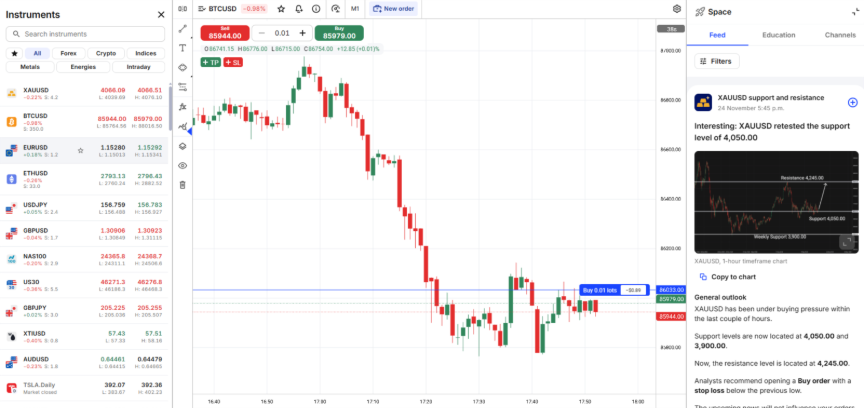
Installation and login are straightforward, with OctaFX providing clear instructions for downloading or accessing each platform, making setup easy even for novice users.
The user interface across platforms is well-regarded. MetaTrader’s interface is standard and familiar for placing orders, using charts, and running indicators. OctaTrader offers a clean design focused on simplicity, with features like one-click trading and easy account switching.
Feedback from TRU members and analysts shows users are generally satisfied, citing ease of navigation and consistent performance.
This sub-factor does not earn a full 5/5 because, while OctaFX’s platform offering is excellent, it is not uniquely innovative. It lacks additional third-party platforms or a revolutionary proprietary system beyond OctaTrader. A few users also report minor slowdowns during extreme volatility—issues common across brokers but worth noting.
For most of the time, OctaFX’s platforms run smoothly. Multi-platform support and user-friendly design align with a score of 4/5: “Very good stability, broad accessibility & strong user experience.” Traders can confidently use OctaFX’s platforms knowing they are feature-rich and reliable across devices.
OctaFX’s trade execution is generally reliable and on par with industry averages, though not without minor issues, earning a moderate score for order quality.
It operates a No Dealing Desk/STP model, which means orders are routed directly to the market or liquidity providers without dealer intervention. Many traders report fast execution speeds, and our test showed an average of about 74 milliseconds, which is strong for a retail broker.
Under normal conditions, slippage is minimal, typically only a few tenths of a pip on major pairs. However, during volatile news events, slippage and requotes occur, suggesting its liquidity or execution engine struggles at peak volatility. This is common, although top-tier ECN brokers often perform better.
We also noted occasional temporary account freezes or delays during high-impact events, possibly due to platform issues or risk controls. OctaFX’s very high leverage, up to 1:500 or 1:1000, can lead to adjustments such as reduced leverage on crypto over weekends or widened spreads, which affect execution indirectly by increasing costs or margin requirements.
Importantly, OctaFX has had no major execution scandals. Allegations of price manipulation in India were denied, and independent checks elsewhere found no evidence of malicious practices. For most purposes, execution appears fair.
Its infrastructure uses servers in strategic locations, reducing latency for different regions. Overall, trade results are comparable to similar brokers, with some slippage in fast markets but nothing excessive.
The score of 3/5 reflects a functional and generally reliable execution environment. It meets retail traders’ needs but does not reach the consistency and precision of top ECN brokers with deeper liquidity networks.
OctaFX offers a sufficient yet fairly standard set of trading tools and analytical resources, earning an average score in this area.
On its platforms, traders have the usual technical analysis features: built-in indicators, charting tools, and multiple time frames. OctaFX supports Expert Advisors (EAs) and custom indicators on MT4/MT5, allowing automated strategies and access to MetaTrader’s extensive plugin library. This is a plus, though it is a general MetaTrader feature rather than something unique to OctaFX.
Additional tools include Autochartist integration, which scans for chart patterns and trading opportunities, and a sentiment indicator on the website showing long/short ratios among OctaFX traders. The site also provides an economic calendar and financial indicators, though these are commonly available elsewhere.
Research offerings are modest. OctaFX publishes market news and occasional analysis but lacks in-depth daily research, premium analytics, or proprietary tools like custom screeners or advanced back-testing found with some competitors.
Essentially, traders rely on MetaTrader’s capabilities and a few add-ons like Autochartist and an economic calendar. This setup is adequate for average traders but does not distinguish OctaFX as a leader in innovation or analytics depth.
Therefore, a 3/5 score is appropriate: OctaFX provides a functional but standard toolset covering essentials for market analysis. Traders seeking advanced tools or comprehensive research will need external services.
OctaFX demonstrates commendable innovation in certain areas and integrates well with popular trading technologies, earning a high score for this sub-factor.
One notable innovation is its proprietary OctaTrader platform. While many brokers rely solely on third-party platforms, OctaFX invested in developing OctaTrader to deliver a streamlined, mobile-friendly experience, showing its commitment to enhancing its product offering. It was also early to adopt cryptocurrency funding and trading, integrating crypto both as instruments and as deposit/withdrawal options (e.g., Bitcoin, USDT), reflecting adaptability to financial trends.
On integrations, OctaFX fully supports MetaTrader 4 and 5 EAs for algorithmic trading and encourages their use by offering resources like a free VPS for 24/7 EA operation. It also integrates Autochartist into MT4/MT5, providing advanced pattern recognition within the platform.
Another innovative service is its Copy Trading app, which offers a full-featured social trading interface with leaderboards and performance stats, accessible via mobile and web, which is far beyond basic MT4 “investor password” following.
In terms of third-party partnerships, aside from Autochartist, OctaFX has not announced major collaborations. The absence of an open API is a minor drawback, as some brokers offer FIX API or similar options for custom integrations. Still, its variety of platforms and value-added services show strong tech adoption.
This adaptability and inclusion of extra functionalities justify a 4/5 rating. It falls short of a perfect score only because there is room for more integrations. Overall, OctaFX proves to be relatively tech-forward for a broker of its class.
Customer Support Quality
OctaFX provides a responsive and multi-channel customer support service that meets a high standard of client satisfaction.
Support is available 24 hours a day, 7 days a week, which means traders can get help at any time, including weekends. OctaFX offers support in at least 10-13 languages, reflecting its global clientele. The primary support channels include live chat, email, and telephone.
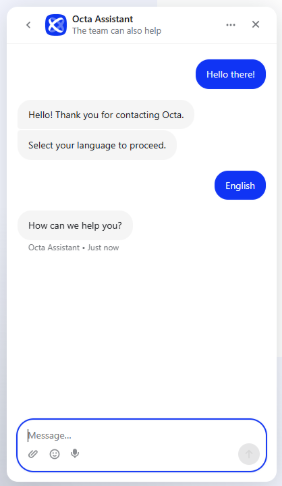
The live chat is prominently available on the website and within the trading app, and it is known for short wait times; our analysts reported being connected to an agent within a couple of minutes or less. The support staff via chat is generally helpful and able to resolve common queries efficiently. Email support is also reliable, typically responding within a few hours. Its phone support provides an additional layer, though many clients might prefer chat for speed.
Quality-wise, OctaFX’s support team tends to be professional and courteous. TRU members praise specific support agents for their clarity and willingness to solve problems. Even during periods of high volume (say, around big promotions or if there’s a technical glitch affecting many clients), it manages to handle the load with maybe slightly longer wait times but still within reason.
There have been some isolated complaints, such as users saying their issue took too long to resolve or that they received scripted answers in complex cases. These are exceptions and often involve more complicated matters, like withdrawal investigations or compliance checks, that inherently take longer.
Another plus is the extensive self-service resources OctaFX provides. A detailed FAQ and Help Center on the website covers many common questions, potentially reducing the need to contact support at all.
The combination of 24/7 availability, multilingual assistance, and effective issue resolution results in a strong performance. Therefore, OctaFX scores 4/5 for support quality, consistent with “reliable and accessible customer service that is quick and helpful, with only minor areas for improvement”. This means most clients are satisfied with the help they receive, and OctaFX demonstrates a commitment to supporting its users beyond just providing a platform.
OctaFX offers a comprehensive set of educational materials and learning tools that cater well to beginners and intermediate traders, putting it in the higher range for this sub-factor.
On the OctaFX website, there is an “Education” section which is well-organized and covers a variety of formats such as written articles, video tutorials, webinars, and FAQs. The content starts from the basics and introduces fundamental and technical analysis concepts. These are useful for novices building foundational knowledge. There are also platform-specific guides (e.g., how to place orders on MT5, how to use OctaTrader features), which help users get up to speed with the practical aspects of using the broker’s tools.
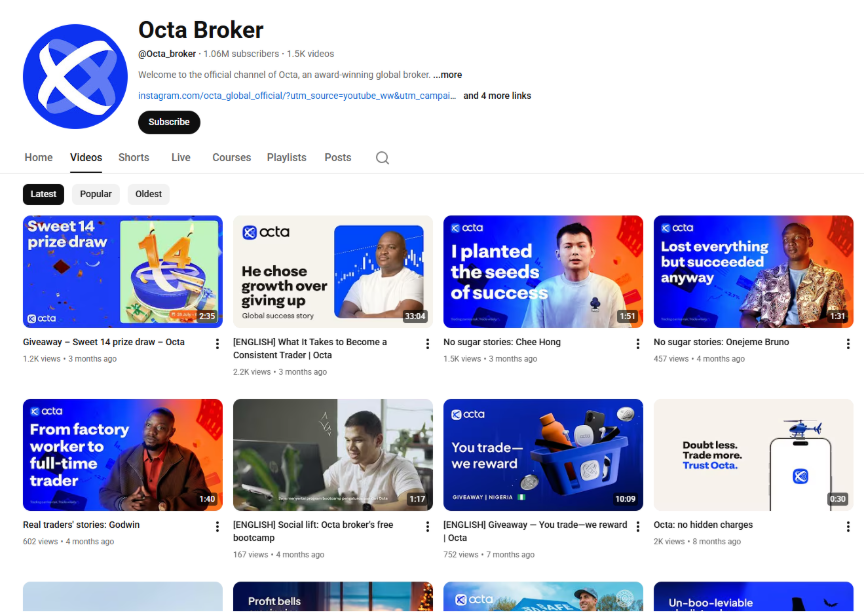
OctaFX hosts regular webinars, sometimes featuring in-house analysts or guest traders, covering topics like trading strategies, risk management, and live market analysis. The webinars are often archived so users can view recordings if they miss the live session. In addition, its YouTube channel contains explainer videos and the recordings of those webinars, making it easy to learn visually.
The educational resources are offered in multiple languages, aligning with OctaFX’s localized approach, which is important because learning in one’s native language can be more effective. They also include a glossary of trading terms and detailed FAQ sections, which double as learning material for platform usage and policies.
Interactive elements like quizzes or trading simulators are not present, but given the free demo accounts offered, users have a way to practice what they learn.
The reason this is not a full 5 is that, while very good, the materials are largely generic to trading. Also, the content is more static educational content as opposed to daily trading ideas, which fall under research. Nonetheless, for a client looking to self-educate, OctaFX provides more than enough to get started and build skills. This merits a 4/5, indicating “well-structured educational offerings with a variety of materials accessible to different experience levels”. It shows OctaFX’s dedication to empowering its traders with knowledge, not just giving them a platform to trade blindly.
OctaFX’s community engagement and auxiliary services are acceptable but somewhat limited, placing it in the mid-range for this sub-factor.
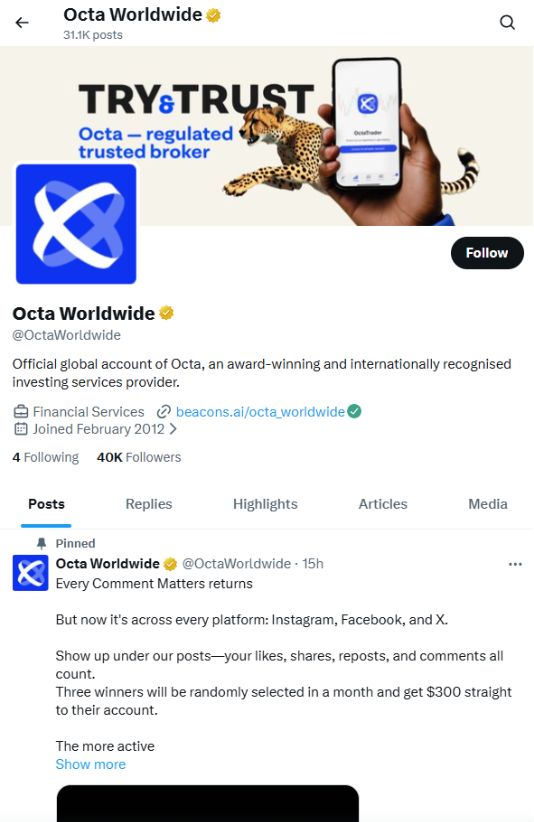
It does not run its own official trader forum or community board on its site, so there is no OctaFX-hosted forum where clients chat or share strategies. However, it does maintain an active presence on popular social media and messaging platforms. They have channels and groups on Telegram, Facebook, YouTube, Instagram, and even TikTok, where they post updates, educational content, and occasionally market insights.
OctaFX’s Copy Trading service can also be seen as a community feature wherein signal providers and followers naturally form a community of sorts where top traders are ranked and followed. While not a discussion forum, it is a social trading network that encourages interaction. Followers can see profiles of master traders, and sometimes communication happens externally.
As for other community initiatives, OctaFX has run trading contests and demo contests where traders compete for prizes, which can create camaraderie and engagement among participants.
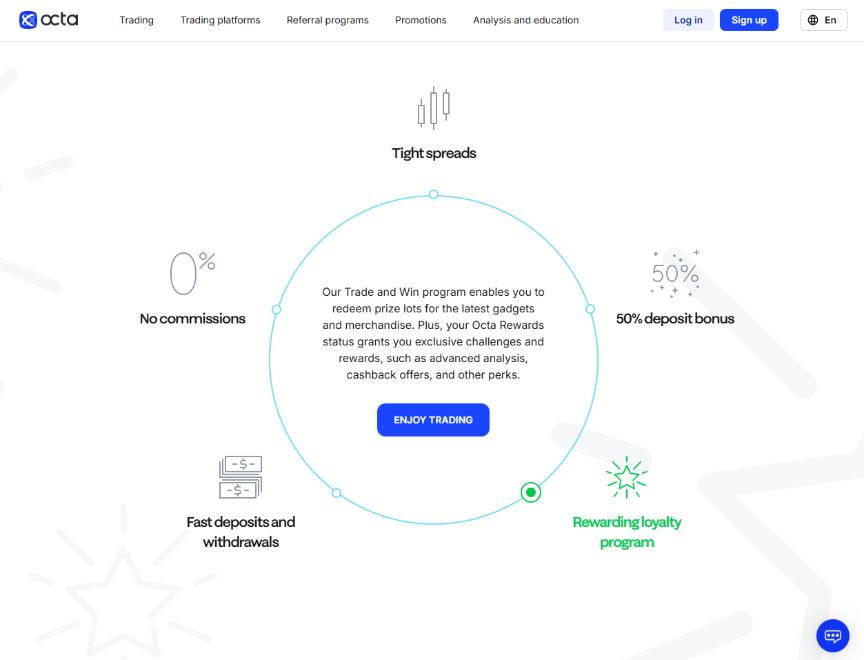
On the value-added services side, aside from what is already covered in this review, OctaFX’s other services include some bonus programs and promotions such as refer-a-friend bonuses, occasional deposit bonuses in eligible countries, and loyalty reward programs where frequent traders can get perks. These can enhance the overall experience for clients by providing extra incentives and a sense of being rewarded for participation.
Taking all into account, OctaFX has enough social and community features to avoid feeling isolated. Traders can engage via social media, partake in contests, and utilize copy trading to connect with the strategies of others. But it does not cultivate a tight-knit proprietary community space or offer extensive mentorship that would mark a top-tier community experience. Thus, a 3/5 is appropriate, aligning with “moderate engagement: active on social channels and basic community features, but nothing highly structured or unique”. Traders using OctaFX will find the environment adequately engaging, though much of the interaction happens on external platforms rather than an OctaFX-owned community forum.
Opening and managing an account with OctaFX is a smooth and user-friendly process, reflecting strong performance in this area.
The account registration is entirely online and can be completed in minutes. Users fill a simple form with their email or sign up via Google/Facebook, then provide personal details. KYC verification is straightforward through the Personal Area, and OctaFX usually verifies documents quite quickly. TRU members report verification within the same day, sometimes within hours, assuming documents are clear.
OctaFX’s onboarding is streamlined with minimal red tape; the $25 minimum deposit means there are no high barriers to entry. Once the account is open, the client dashboard is well-designed and consolidated.
The TRU Comprehensive Organization Rating (COR) is an evidence-based scoring framework that evaluates a company across key dimensions that matter to traders and platform users. It is designed to provide a standardized and objective view of a firm beyond popularity or isolated user opinions.