
To assess this subfactor under the COR matrix, the review begins with the availability and clarity of company registration details. TradingPro presents its registered entities, including company names and registration numbers, directly on its website. The disclosed entries are:
TradingPro International (Pty) Ltd – Reg. No. 2014/202132/07
TradingPro International Limited – Reg. No. 208079 GBC
Verification was conducted through official registries, where both entities were confirmed as legally incorporated and active. The published details are sufficient for independent checks, though the process requires manual lookup across separate sources rather than a single reference point.
A gap remains in the disclosure of other previously associated entities, particularly earlier offshore registrations that are not presented on the main site. This does not invalidate the confirmed registrations but reduces completeness and makes full corporate mapping less straightforward.
Based on the COR criteria, the company meets the standard for published and verifiable registration details, though not in a fully complete or centralized manner. This supports the assigned 4/5 rating.
TradingPro’s jurisdictional footprint was reviewed based on its disclosed entities and corresponding registry records. The company operates through the following jurisdictions under the COR tier classification:
South Africa – Tier 2
Mauritius – Tier 3
The presence of South Africa places part of the company’s structure within a Tier 2 jurisdiction, which carries moderate international recognition. Mauritius is classified as a Tier 3 jurisdiction and is commonly used for international operations under a more permissive environment. TradingPro’s global structure relies on these two jurisdictions, with no registration in Tier 1 regions such as the United Kingdom, Australia, or other major financial centers.
Under the COR matrix, the presence of a Tier 2 jurisdiction supports a 4/5 rating.
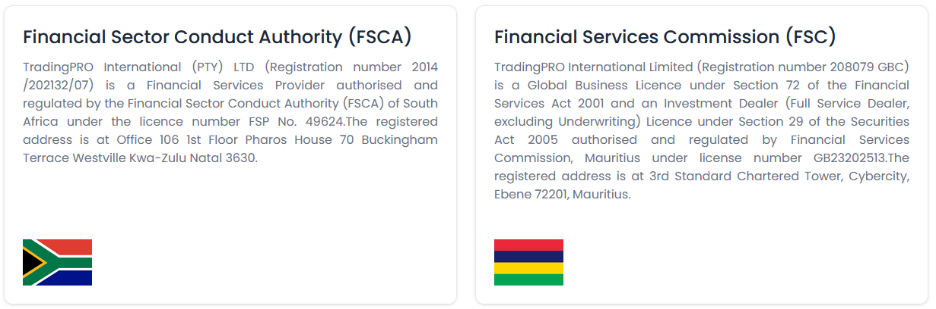
The broker holds two verified licenses listed on the regulators’ official websites. These credentials confirm formal authorization and adherence to the minimum legal and operational requirements within their jurisdictions. Verification of these licenses requires only a check against the official regulator records, which confirms their authenticity.
The table below summarizes the licenses:
Regulator | License Number | Status |
Financial Sector Conduct Authority (FSCA), South Africa | FSP 49624 | Licensed and verified |
Financial Services Commission (FSC), Mauritius | Full Service Investment Dealer | Licensed and verified |
These licenses provide oversight and a degree of investor protection. The score accounts for the verified status of the licenses while noting that the regulatory coverage is limited to mid-tier jurisdictions.
TradingPro holds licenses with mid- and lower-tier regulators, the FSCA (South Africa) and FSC (Mauritius), which provide formal authorization but moderate global credibility under the COR framework.
Regulator | Tier Level | Reputation / Oversight |
Financial Sector Conduct Authority (FSCA), South Africa | Tier 2 | Legal framework in place; limited enforcement; no government-backed client protection |
Financial Services Commission (FSC), Mauritius | Tier 3 | Offshore regulator; light-touch supervision; limited protections for international clients |
Lower-tier regulators may limit leverage, instruments, and dispute resolution. Enforcement is generally slower and less comprehensive than Tier-1 oversight. Regulatory watchdogs confirm these authorities meet legal minimums but do not consistently match top-tier rigor.
The presence of a Tier-2 regulator provides moderate credibility, while Tier-3 adds flexibility but limited safeguards. This combination supports a 4/5 rating for Regulatory Reputation.
In June 2025, the UK Financial Conduct Authority (FCA) issued a warning against “Trading PRO / TradingPro,” citing operations without proper authorization and advising the public to avoid the platform. FCA warnings indicate serious regulatory breaches and potential illegal activity.
Industry investigations further highlight questionable practices. TradingPro referenced registrations in St. Vincent and Vanuatu as regulatory credentials, though these do not provide legitimate brokerage authorization. Differences in the FSCA entity’s listed address versus official records raise concerns about potential misrepresentation of its licensed entity.
Under the COR framework, this warrants a 2/5 rating, categorized as “Poor Compliance History.” The score is above the lowest because no additional sanctions or confirmed fraud convictions exist.
TradingPro implements standard cybersecurity measures that align with common industry practices. Connections to its website and client portal use SSL/TLS encryption to secure data in transit. Clients can enable two-factor authentication (2FA) for an additional layer of login protection. Privacy policies state that all client data is encrypted and always safeguarded. Secure subdomains host the client portal, ensuring that access to sensitive information is protected.
Despite these measures, TradingPro does not provide evidence of independent security audits, ISO 27001 certification, SOC 2 reports, or advanced protections such as real-time intrusion detection, DDoS mitigation, or cyber-insurance. Publicly available information on security procedures beyond encryption and 2FA is limited, leaving gaps in transparency regarding comprehensive cyber resilience. No known breaches have been reported,
The broker’s cybersecurity practices cover fundamental protections but lack verifiable advanced measures or external audits. This aligns with a 3/5 rating, indicating adequate IT safety that meets industry standards but does not exceed them.
This sub-factor examined how client funds are handled, what safeguards are in place during trading losses, and what protection remains if the broker faces financial failure.
Observed Protection Measures
Segregation of Funds
Client deposits are kept in separate accounts from company funds, following FSCA and FSC requirements. This setup limits direct access of operational funds to client balances.
Negative Balance Protection
Accounts are prevented from going below zero. If losses exceed deposits during extreme volatility, the deficit is absorbed internally. Clients are not pursued for repayment.
Limitations and Risk Factors
No Compensation Scheme
There is no investor compensation program tied to either jurisdiction. In the event of insolvency, recovery depends on legal proceedings rather than guaranteed reimbursement.
No Insurance Coverage
No evidence of private insurance or third-party protection mechanisms that could cover client balances beyond regulatory requirements.
Limited External Verification
Entities operating under Mauritius provide limited public financial reporting. Independent confirmation of how client funds are managed remains restricted.
High Leverage Exposure
Leverage reaching 2000:1 increases the chance of rapid balance depletion. Negative balance protection removes debt risk but does not preserve capital once losses occur.
The protection structure covers the minimum expected safeguards. Segregation and balance protection are in place, but external security layers are absent. Clients rely heavily on internal controls and jurisdictional processes if issues arise. Under the COR framework, this level of coverage supports a 2/5 rating due to the lack of compensation schemes and limited protection beyond baseline requirements.
The available markets cover the core asset classes expected from a retail CFD broker. The selection allows exposure to the main segments of global markets, but it does not extend beyond the standard set.
Available Asset Classes
Forex
Commodities
Indices
Equities
Cryptocurrencies
These five categories support basic portfolio diversification across currencies, raw materials, global stock markets, and digital assets. This range meets the common needs of retail traders and aligns with the typical structure of CFD-focused platforms.
Under the COR matrix, five asset classes fall within the mid-range coverage tier. This supports a 3/5 rating, where the selection is sufficient for general trading activity but does not reach the breadth required for higher classification.
Based on the available listings at the time of this review, the instrument counts across each asset class are as follows. These figures reflect the current catalog and may change as the broker updates its offerings.
Asset Class | Instrument Coverage Description | Total Instruments |
Forex | Major, minor, and selected exotic currency pairs | 52 |
Equities (CFDs) | Large-cap global stocks | 134 |
Indices | Major global equity indices | 14 |
Commodities | Metals and energy products | 5 |
Cryptocurrencies | Major digital assets | 11 |
Total | 216 | |
The distribution shows a concentration in equity CFDs and a standard range of forex pairs. Indices and cryptocurrencies remain within typical coverage, while commodities are limited to core markets. Availability also varies by account type, with the full instrument range primarily accessible on higher-tier accounts.
Under the COR matrix, this total across multiple asset classes falls within the mid-range category for instrument diversity. The confirmed total of 216 instruments aligns with this range which is aligned with the 3/5 rating.
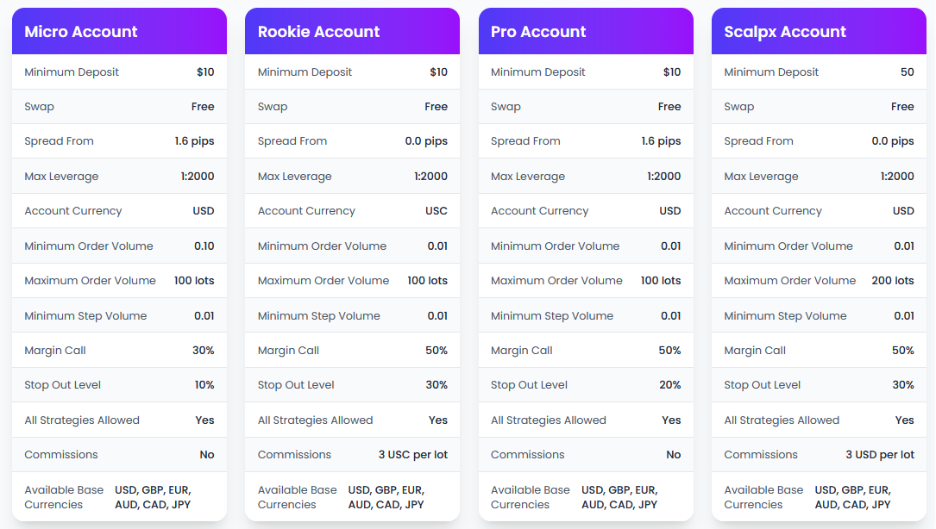
The account structure is clearly defined and designed to accommodate both entry-level and active traders. Minimum deposit requirements are low, and account conditions are transparent at the point of onboarding.
Account Type | Minimum Deposit | Key Characteristics | Intended User Profile |
Micro (MT4) | $1 | Standard spreads, no commission | Beginners |
Rookie (MT4/MT5 Cent) | $1 | Cent-denominated, raw spreads with commission | Beginners testing small positions |
Pro (MT4/MT5) | $10 | Standard spreads, broader access than entry accounts | Regular retail traders |
ScalpX (cTrader) | $50 | Raw spreads, commission-based, full instrument access | Active and experienced traders |
The structure allows progression without high capital requirements. Entry starts at $1, which lowers the barrier for new users. The cent-based account further reduces exposure by scaling trade sizes. Higher-tier accounts provide full access to available instruments and tighter pricing models without requiring large deposits.
Swap-free options are available across account types, supporting clients who require interest-free trading. Base currency selection includes several major currencies, which helps reduce conversion costs. Account setup is completed online, with no complex onboarding requirements.
The range is practical but not extensive. All accounts operate under the same leveraged CFD structure, and there are no distinct categories such as direct market access or long-term investment accounts.
Under the COR matrix, this setup falls within “Differentiated and Accessible.” Multiple account types are available, entry requirements are minimal, and conditions are clearly defined. The absence of broader account variations keeps the rating at 4/5.
Based on the current review, TradingPro provides a broad set of supplementary services that extend beyond core trading. These offerings are active at the time of assessment and may change as the broker updates its ecosystem.
Available Additional Services
Copy & Social Trading
Internal copy trading and PAMM-style allocation systems are available. Clients can allocate capital to strategy providers or offer their own strategies for others to follow, supporting both passive engagement and performance-based participation.
Trading Tools & Analytics
Trading Central integration provides technical analysis, trade ideas, and market insights. A proprietary “Trade Hub” is also available, incorporating sentiment indicators, market signals, and an economic calendar within a single interface.
Education & Community Access
Educational support includes webinars, regional seminars, and basic learning materials. Content availability varies by region and is supported by community channels such as messaging groups and social platforms. Coverage remains introductory, with no structured forex education program or dedicated webinar series focused purely on trading fundamentals.
Promotions & Incentives
The broker offers trading contests, rebate programs, and time-limited bonuses. These are typically volume-based and include cashback incentives and competitive trading events.
Partnership Program
A structured IB and affiliate system is in place, supported by a partner portal and commission-based rewards. This supports client acquisition and regional expansion through third-party networks.
Proprietary Prop Trading Program
A separate funded trading model (“TradingPLUS”) is available, allowing users to complete evaluation phases in exchange for access to funded accounts under profit-sharing terms.
The service range is broad and supports both active and passive participation. Analytical tools and copy trading add practical value, though educational depth remains limited and lacks a structured progression. This places the offering above standard retail coverage but short of more developed ecosystems with institutional-grade research or advanced trader development programs, supporting a 4/5 rating under the COR framework.
Upon checking the available information on the broker’s website and related disclosures at the time of this assessment, the following details were identified to evaluate transparency and verifiability:
Disclosed Information
Operating entities are named (e.g., TradingPro International Limited and related entities)
Registered business addresses are provided
Multi-jurisdictional presence is indicated
Undisclosed Information
Ultimate beneficial owners or controlling shareholders
Board of directors, executives, or management team
Parent or holding company structure
Clear explanation of how branded entities are connected
Audited financial statements or capitalization details
The broker limits its disclosures to entity names and basic registration information. There is no centralized corporate profile that clearly presents ownership, governance, or leadership structure. These details are not readily visible on client-facing pages and require users to piece together information from separate sections.
Verification of deeper corporate structure relies on external records, which are not consistently accessible or consolidated. Address information also shows variation between publicly displayed broker details and regulatory listings, which introduces uncertainty when mapping the exact operating entity. In addition, branding variations such as “TradingPro” and “Trading PRO” are used without formal clarification of how these relate within a single group structure.
Overall corporate clarity remains limited, with no disclosed ownership or governance framework that allows clients to identify who ultimately controls or oversees the business.
As a result, a 2/5 rating is assigned to this sub-factor. The broker meets the minimum threshold of disclosing legal entities, but falls short of providing transparent and verifiable ownership and governance details. This aligns with the COR definition of “Limited transparency and difficult verification,” where structural accountability cannot be independently confirmed with ease.
TradingPro shows a broad digital reach supported by localized services across multiple regions. However, its presence remains largely offshore with limited formal establishments in major financial centers.
Aspect | Details |
Client Reach | Reported access to clients in 180+ countries (broker-stated figure) |
Website Localization | Multi-language support, including English, Filipino (Tagalog), Indonesian, Vietnamese, Arabic, and others |
Regional Focus | Strong orientation toward Southeast Asia, MENA, and parts of Africa |
Payments Localization | Local funding methods such as e-wallets and regional bank transfer options (e.g., DragonPay, PromptPay) |
Physical Presence | Limited confirmed offices; operations primarily centered in Mauritius and South Africa |
Market Restrictions | Not available in several regulated markets, including the US, EU, Canada, Australia, and Japan |
The broker demonstrates clear efforts to expand its reach through digital channels and localized infrastructure. Language support, regional payment methods, and region-specific promotions indicate an active strategy to serve emerging markets, particularly in Southeast Asia and Africa. Engagement through partner networks and event participation also contributes to its visibility in these regions.
At the same time, its footprint remains concentrated in offshore jurisdictions, with no strong operational base in major Tier-1 financial hubs. Access is also restricted in multiple regulated markets, limiting its formal global coverage. The absence of a wide network of established regional offices further reinforces its online-only expansion model rather than physical market penetration.
Overall, TradingPro maintains a wide but primarily offshore-driven reach. Its presence is strong in terms of accessibility and localization, but limited in formal regulatory footprint and institutional presence across major financial centers.
As we align this in the COR matrix, the evidence is aligned to the 3/5 rating definition of “moderate global reach with strong digital expansion but limited Tier-1 market presence,” where brokers operate broadly online but without deep structural establishment in leading jurisdictions.
Based on the review conducted at the time of assessment, TradingPro provides a complete set of legal and policy documents through its website. All materials are publicly accessible without registration, allowing users to review conditions before opening an account.
Available Legal Documents
Client Agreement
Risk Disclosure
Privacy Policy
Order Execution Policy
Withdrawal Policy
Anti-Money Laundering (AML) Policy
The broker covers the core areas expected in client-broker documentation. The Client Agreement sets out contractual terms, including account conditions, withdrawal rules, fee-related provisions, and risk handling. Supporting policies address compliance, data protection, execution standards, and operational safeguards. Across the documents, the information remains consistent with no direct contradictions identified.
Access is straightforward, though the structure is fragmented. Key details are distributed across multiple legal pages, account sections, and FAQs rather than being consolidated into a single reference point. This requires users to move between sections to form a complete understanding of the terms.
Clarity is the main limitation. The documents use formal legal wording, with long clauses and limited simplification for retail users. There are no summarized key points, plain-language breakdowns, or quick-reference guides to support easier interpretation. English also appears to be the only language used for legal documentation despite broader website localization.
As a result, the 3/5 rating is assigned. The broker meets baseline requirements by publishing its full legal framework and making it publicly available. However, the presentation remains standard and not user-oriented in terms of readability or structure. This fits the COR definition of adequate transparency, where disclosure is complete but not simplified for practical user understanding.
TradingPro uses a dual pricing structure combining spread-only accounts and raw spread accounts with low commissions. Overall pricing remains below typical retail averages, especially on major FX instruments.
Account Type | Pricing Model | Typical EUR/USD Cost | Structure |
Micro / Pro | Spread-only | ~1.0–2.0 pips | Commission-free pricing |
Rookie / ScalpX | Raw spread + commission | ~0.0–0.3 pips + ~$3 per lot round-turn | Tight spreads with fixed commission |
A swap-free condition applies across all accounts. Positions held overnight do not incur financing charges, which removes a common cost component found in most brokers. This applies uniformly across account types and instruments.
Trading conditions remain centered on spread and commission pricing, with no separate trading penalties or execution-based add-on fees indicated in the fee structure.
Cost efficiency is stronger on raw spread accounts due to lower commission levels compared to standard ECN market ranges. Standard accounts remain competitive for simpler, spread-based trading setups.
Price behavior across instruments can vary under market volatility, particularly outside major FX pairs, where spreads widen in line with broader market conditions.
Pricing sits in the lower range of retail brokerage costs, supported by tight execution on raw accounts and the absence of swap charges. The structure does not consistently reach the lowest-cost tier across all instruments, which keeps the score below top band classification under the COR matrix.
We reviewed TradingPro’s funding system using its published policies, supported disclosures, and user feedback to assess how deposits and withdrawals are handled in practice. The evaluation focuses on cost transparency, method coverage, processing speed, and access conditions.
Feature | Details |
Broker fees | No internal charges for deposits or withdrawals. Official policy confirms no additional commission on deposits, and client feedback consistently reports zero funding fees. Any external charges from banks or payment processors are generally avoided or absorbed where possible. |
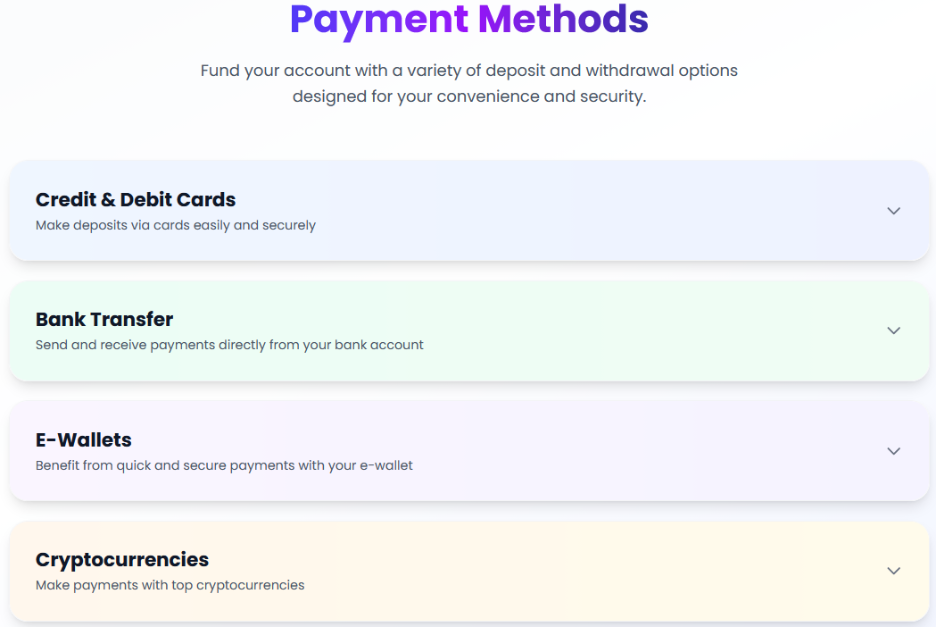
Funding methods | Credit/debit cards, bank transfers, multiple local bank channels (including regional payment gateways), e-wallets such as Neteller and Sticpay, and cryptocurrency options for both deposits and withdrawals. |
Processing speed | Deposits are typically instant or near-instant, depending on the method. Withdrawals are commonly processed within 24 hours, with many cases completed the same day once approved. |
Minimum withdrawal | Low entry thresholds across several methods, with some options allowing withdrawals from approximately $2–$5, depending on the payment channel. |
Transparency of charges | No separate administrative or handling fees are applied at the account level. Funding pages list methods and processing times without fee deductions applied to transactions. |
The funding structure is defined by the absence of internal transaction costs and broad payment accessibility. Deposits are credited in full, and withdrawals are generally processed without deductions from the broker side. Processing efficiency is supported by extended operating hours for payment handling, which helps reduce backlog and delays.
Execution in practice is generally consistent with advertised timelines, with most withdrawals completed within the same day or within 24 hours, depending on verification status and payment method. This creates relatively smooth capital access compared to standard retail brokerage timelines.
The 5/5 rating is supported under the COR framework due to zero internal funding fees, broad payment coverage, fast withdrawal turnaround, and consistently transparent handling of client funds, placing TradingPro at the highest tier for deposit and withdrawal efficiency.
TradingPro’s cost structure keeps account ownership free from recurring or administrative deductions. Fees are not applied for holding an account, accessing trading platforms, or maintaining idle balances, which keeps non-trading costs effectively absent under normal use.
Observed Non-trading Fee Exemptions:
No inactivity or dormant-account fees
No account-opening, maintenance, or closure charges
No platform-access or subscription fees
No internal transfer fees between accounts
No administrative charges for standard account requests or documentation
No broker-imposed conversion markups on standard funding flow
No demo account usage fees
Core account functions, including registration, platform access, and ongoing account maintenance, remain free of charge. TradingPro does not impose periodic service deductions or balance-based penalties, and account activity level does not affect cost exposure.
Funding-related costs are also limited to external providers when applicable, rather than broker-imposed deductions. Any conversion or processing charges originate from third-party payment systems, not TradingPro’s internal fee structure.
There are no indications of inactivity penalties or account service charges within the reviewed documentation, which removes one of the most common non-trading cost drivers seen in retail brokerage models.
The 5/5 rating is supported under the COR framework due to the absence of account-level fees across maintenance, inactivity, and platform access, and this is aligned with its clean and predictable non-trading cost profile.
The broker’s platform availability is reviewed below, focusing on access across devices, usability, and overall platform reliability.
Platform | Type | Devices | Assessment |
MetaTrader 4 (MT4) | Third-party | Desktop, Mobile, Web | Standard trading platform with a stable interface and basic tools |
MetaTrader 5 (MT5) | Third-party | Desktop, Mobile, Web | Expanded functionality with additional order types and multi-asset support |
TradingPRO App | Proprietary (Mobile) | iOS / Android | Mobile-focused trading and account access |
MT4 and MT5 are available across desktop, web, and mobile, with straightforward installation and browser-based access. Interfaces follow standard MetaTrader layouts, making navigation familiar for most users.
The TradingPRO app supports mobile trading and account management, but full functionality remains centered on MT4 and MT5. Platform performance is stable under normal conditions, with occasional minor synchronization delays typical of third-party systems.
The setup covers all essential access points and maintains consistent usability across devices. However, the offering remains limited to standard third-party platforms, with no proprietary desktop system or additional platform options.
A 3/5 rating is assigned under the COR framework, as the platform environment is stable and accessible but aligns with standard industry offerings rather than a broader or more advanced platform ecosystem.
We conducted a hands-on assessment of TradingPro’s order execution through structured testing by our technical team, focusing specifically on order processing behavior, fill consistency, pricing alignment, and slippage under varying market conditions.
TradingPro operates an NDD (No Dealing Desk) execution model using STP-style routing, where client orders are transmitted to external liquidity providers rather than being internally matched. This structure supports market-based execution and reduces direct broker intervention in order handling.
Execution Speed and Order Processing - Execution is generally fast under normal market conditions, with market orders typically filled in sub-second timeframes. Orders are processed without requotes in standard liquidity environments, and fills generally align closely with requested prices during stable market phases.
Slippage Behavior - Slippage remains limited during low to moderate volatility, with minimal deviation between requested and executed prices for both market and pending orders. During high-impact events or rapid price movements, slippage becomes more visible, reflecting the natural impact of external liquidity conditions on order execution.
Pricing and Fill Consistency - Order fills remain consistent in normal conditions, with no frequent requotes or systematic order rejection behavior observed. Execution follows external price movement without signs of internal price manipulation, with outcomes primarily dependent on live market liquidity.
Execution Transparency - Publicly available details on execution mechanics are limited, particularly regarding liquidity sourcing and granular execution statistics such as fill distribution or slippage breakdowns. This limits full external verification of execution performance beyond observable trading outcomes.
Market Condition Sensitivity - Execution remains stable under normal trading conditions but becomes more variable during periods of high volatility or reduced liquidity, which is consistent with external liquidity-driven execution models.
The 3/5 rating corresponds to a generally reliable execution with acceptable speed and consistent order handling under normal market conditions, while moderate slippage during volatility and limited execution transparency prevent classification within higher performance tiers.
We evaluated the trading tools and analytical resources across MT4, MT5, cTrader, and the broker’s client environment to assess the depth, usability, and practical effectiveness of its market analysis offering.
The broker provides a standard suite of platform-based technical analysis tools across MT4, MT5, and cTrader.
Tool / Feature | Type | Function |
Technical Indicators (RSI, MACD, Moving Averages, Oscillators) | Platform-native | Core chart analysis and trend identification |
Drawing Tools (Trend lines, Fibonacci, Support/Resistance) | Platform-native | Chart structuring and technical mapping |
Multi-timeframe Charts | Platform-native | Market analysis across different time horizons |
Expert Advisors (MT4/MT5) / cBots (cTrader) | Automated tools | Algorithmic and rule-based trading strategies |
Trading Central | Third-party integration | Pattern recognition, technical summaries, and market signals |
Economic Calendar | Integrated tool | Macro event tracking with impact classification |
Trade Hub Sentiment Tool | Proprietary layer | Bullish/bearish sentiment and market mood indicators |
Platform-native tools provide full technical functionality, including indicators, charting systems, and automated trading capabilities. These are supported across all major trading environments, allowing structured technical analysis and strategy execution.
Trading Central extends analytical capability through structured market insights, pattern detection, and instrument-level commentary. The economic calendar adds macroeconomic awareness by tracking scheduled events and their expected market impact.
A sentiment feature within the Trade Hub environment provides simplified market positioning based on aggregated news and sentiment signals, supporting short-term directional interpretation.
The overall toolkit remains functional and covers core analytical requirements for retail trading, particularly for technical and sentiment-driven strategies. However, analytical depth is largely dependent on third-party integration and platform-native tools rather than in-house research development.
The 3/5 rating is supported by the availability of essential technical tools, economic data access, and third-party analytics support, while the absence of advanced proprietary research systems and deeper analytical infrastructure limits classification within higher COR analytical tiers.
The broker demonstrates above-average innovation through multi-platform connectivity, embedded trading systems, and selective adoption of fintech integrations. Its ecosystem focuses on combining industry-standard trading infrastructure with light proprietary enhancements to improve usability and access.
Key Features:
Multi-Platform Infrastructure (MT4 / MT5 / cTrader) - Supports multiple trading platforms under a unified account system, which allows flexible access across different execution environments without operational fragmentation.
Copy Trading System - Offers an integrated social trading setup where users can follow and replicate strategies within the broker’s ecosystem. This reduces reliance on external copy trading providers.
Prop Trading Program Integration - Includes a funded trading model embedded within the trading environment, linking evaluation-based capital access with live market execution.
Cryptocurrency Funding & CFDs - Supports crypto deposits and withdrawals alongside crypto CFD trading, expanding funding flexibility and trading instrument access.
Third-Party Analytics Integration (Trading Central) - Integrates external analytics tools directly into the platform, providing market insights and signals within the client environment.
Centralized Client Dashboard - Provides a unified portal for trading accounts, funding, copy trading, and account management within a single interface.
Mobile Application Integration - Extends core trading and account management functions to mobile devices, supporting trading access and operational control on the go.
Overall, the ecosystem is well integrated and functionally diverse, with its strongest innovation areas in copy trading and funded trading infrastructure. However, innovation depth remains moderate due to limited developer-level infrastructure and the absence of advanced open system connectivity.
Strong platform integration, diversified trading systems, and adoption of modern trading models support the 4/5 score. The rating is capped due to limited institutional-grade APIs and deeper technological extensibility.
We evaluated the broker’s customer support based on response speed, communication channels, availability, and effectiveness in resolving client queries. The support framework is structured to serve global clients with continuous accessibility and multi-channel communication.
Observations from evaluation:
24/7 availability: Customer support is available around the clock, including weekends, allowing clients across different time zones to access assistance at any time.
Multiple support channels: Clients can reach support via live chat, email, phone, and messaging platforms such as WhatsApp and Telegram, providing flexible communication options depending on user preference and urgency.
Response efficiency: Live chat typically connects to an agent within minutes, making it the fastest support channel. Email responses are generally delivered within the same day, depending on query complexity.
Practical assistance: Support agents effectively handle standard requests such as account setup, verification, platform navigation, and funding-related inquiries with clear and direct guidance.
Issue resolution quality: Most routine issues are resolved efficiently, though more technical or complex cases may require follow-up or escalation for full clarification. Initial responses to advanced queries can occasionally be general and require additional detail upon request.
Overall, the support structure is reliable and accessible, with strong responsiveness and broad channel coverage. It performs well in handling day-to-day trading and account-related needs for a global client base.
The 4/5 rating aligns with the “Very Good Customer Support” category under the COR matrix, which is defined as fast response times, 24/7 availability, and multi-channel accessibility. The score is moderated by occasional limitations in depth of resolution for complex or highly technical inquiries.
The broker provides educational materials intended to support early-stage and developing traders. These resources are available across different sections of the website and are not consolidated into a single structured learning hub.
Scope and structure of educational materials:
Distributed content layout - Learning materials are spread across the Blog, Media pages, and Help Center. Users need to move between sections to gather information, as there is no unified academy or structured learning track.
Introductory trading coverage - Blog articles focus on basic forex concepts such as pips, leverage, margin, order types, and general market mechanics. The content is directed mainly at beginners, building initial understanding.
General trading guidance - Additional articles cover basic trading behavior, common mistakes, and simple strategy discussions. These materials remain broad and do not progress into advanced or systematic strategy development.
Video tutorials - Educational videos are available through social channels and video platforms. Content includes platform walkthroughs, account processes such as deposits and withdrawals, copy trading explanations, and basic usage guides. These materials also function as onboarding support.
Webinars and live sessions - Webinars are conducted periodically, with some sessions adjusted for specific regions and languages. Topics usually involve basic trading education, platform orientation, and general market explanations. Selected sessions are recorded for later access.
Help Center reference materials - The FAQ section includes explanations of account functions, trading conditions, and platform tools. It also defines basic trading terms, although explanations remain limited in depth.
Localized educational access - Some materials are adapted for regional audiences, including Tagalog and other Asian languages. This improves accessibility for beginners in non-English-speaking markets and is supplemented by occasional regional sessions.
The overall structure provides practical entry-level learning support through written guides, videos, and webinars. However, the materials remain fragmented and do not follow a progressive learning system.
Advanced topics and deeper analytical training are limited, and there is no clear pathway that guides users from beginner concepts toward more advanced trading education.
The 4/5 score demonstrates a solid but basic educational setup. Coverage of beginner topics is consistent, and accessibility is strong across multiple formats. The absence of a centralized learning structure, limited depth beyond introductory material, and the lack of a continuous or advanced learning framework moderate the rating.
The broker maintains several engagement channels and supplementary services that allow client interaction and participation, although these are not built within a centralized community system.
Community structure and engagement channels:
No internal community platform: There is no in-house forum or discussion space for traders. Interaction does not take place within a dedicated broker-managed environment.
Social media-driven interaction: Updates and discussions are handled through external channels such as Telegram, Facebook, Instagram, TikTok, and YouTube. Client engagement happens mainly through comments and public posts.
Copy trading visibility: The copy trading feature allows users to follow strategy providers and view performance data. Interaction is indirect and limited to observation rather than direct communication.
Trading contests and promotions: Periodic competitions and campaign-based events encourage participation among traders. These initiatives create short-term engagement but do not form a continuous community structure.
Referral and partner programs: IB and referral systems create small networks of participants focused on commissions and trading activity sharing, although these function more as commercial arrangements.
Regional events and expos: Occasional meetups and expo participation provide offline interaction in selected regions, but coverage is not consistent across all markets.
CSR initiatives: Community projects are occasionally highlighted as part of brand activity, though they do not directly contribute to trader interaction.
Overall engagement remains fragmented across external platforms and promotional programs without a unified communication space for traders.

The 3/5 mid-range score aligns with moderate community support under COR criteria. Engagement is present through social channels, copy trading visibility, contests, and referral programs, yet the absence of a dedicated community platform and limited direct trader interaction keeps the structure at a mid-level range.
The account opening and management process is fully digital and built around a centralized client dashboard that supports registration, verification, funding, and account adjustments in a single environment. The flow is generally smooth, with minimal steps required before a client can begin trading.
Step-by-step account process:
Step 1: Account registration and initial access
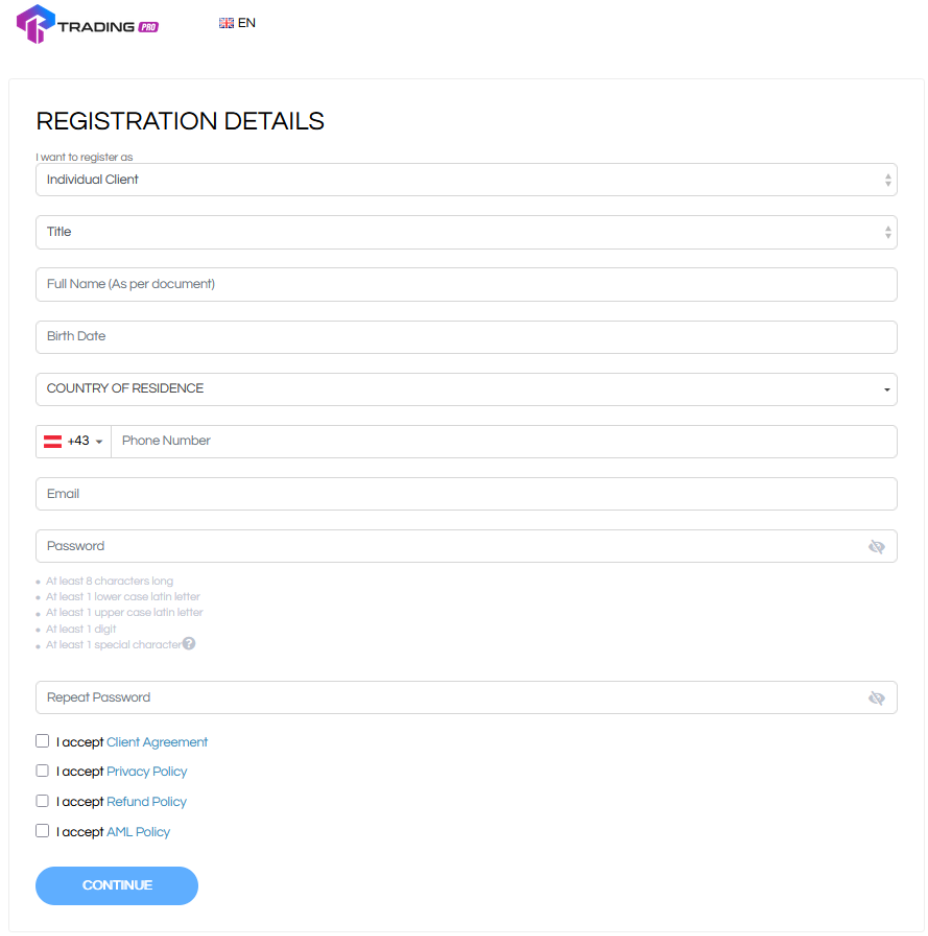
Account creation is completed online through a short registration form requiring basic personal details. Social login options such as Google and Facebook are available. Access to the client area is granted shortly after submission, with login credentials delivered electronically.
Step 2: Client area setup and navigation
Once logged in, users are directed to a centralized dashboard where core account functions are available. The interface provides access to trading accounts, funding tools, and platform links in a single layout designed for quick navigation.
Step 3: Identity verification (KYC process)
Verification requires submission of standard documents such as a government-issued ID and proof of residence. Uploads are completed directly within the client area. Processing is generally completed within the same day when documents are clear and valid.
Step 4: Account activation and funding
After verification, accounts can be funded using available payment methods such as cards and e-wallets. The low minimum deposit requirement allows trading access to be activated quickly once funds are credited.
Step 5: Internal transfers and account control
The dashboard supports internal fund transfers between trading accounts without external processing delays. Users can also open additional accounts, adjust leverage within allowed limits, and manage account settings such as passwords and swap-free status.
Step 6: Ongoing account management
All routine account functions are handled through the same interface, including switching between demo and live accounts, monitoring balances, accessing trading platforms, and managing basic profile settings. Most actions are self-service and do not require support intervention.
The overall onboarding and management structure is efficient and centralized, allowing traders to move from registration to live trading with limited friction. The system prioritizes self-service control and quick access to trading functionality.
Minor limitations are present in terms of deeper automation and more advanced customization options within the account settings. These do not materially affect day-to-day usability.
The 4/5 score aligns with a strong and efficient onboarding experience under COR criteria. The broker provides fast registration, generally quick KYC processing, and a well-organized dashboard that supports smooth account management. The rating is moderated by the absence of more advanced automation features and limited depth in account customization tools.
The TRU Comprehensive Organization Rating (COR) is an evidence-based scoring framework that evaluates a company across key dimensions that matter to traders and platform users. It is designed to provide a standardized and objective view of a firm beyond popularity or isolated user opinions.